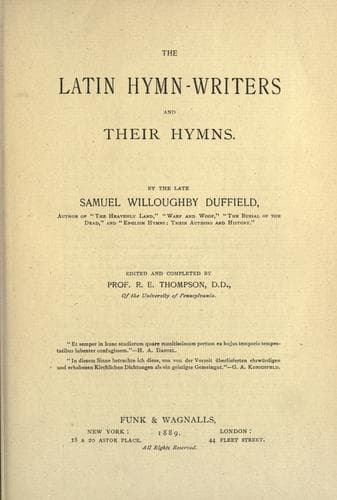
The Latin Hymn-writers and Their HymnsDuffield, Samuel Willoughby
Religion
The Latin Hymn-writers and Their Hymns
Duffield, Samuel Willoughby
Hymns, Latin -- History and criticism
The purpose of the embassy was to obtain from the Byzantine Emperor
Anastasius, at that time a man of great age, the recognition of
Hormisdas, the ruling Pope, as the supreme religious head of both
empires. It was a delicate negotiation, and it demanded a perfectly
incorruptible adherence to the interests of Rome. In this respect
Ennodius stood pre-eminent as what Mosheim styles an “infatuated
adulator of the Roman pontiff,” and as a master of the style then
required in a diplomat. He had (in 503) eulogized Pope Symmachus,
calling him “one who judged in the place of God” (_vice Dei judicare_)
and again (in 507) he had published a panegyric on Theodoric, the Gothic
King of Italy, which had all the absurd flattery of that species of
composition. To crown these he was the obedient occupant of the see of
Pavia. He was therefore just the man to do the work of the relentless
and uncompromising Pope.
Caelius Hormisdas was a man who never yielded, never forgot, and never
relaxed a purpose. Such men, backed by a sufficient power, wring from a
reluctant world about all that they have determined to secure. But to
the obstinate will of the Pope was opposed the no less obstinate will of
the old Emperor—now fully eighty-five years of age—and quite as grim in
his methods as any Hormisdas. It was to be a battle of giants and the
intermediates might look for little favor. The opportunity for the
negotiation itself happened to occur in an unusual way. Vitalianus,
commander of the Imperial Byzantine cavalry, had taken arms against the
Emperor; had defeated and put to death Cyril, the opposing general, and
had then marched to the very gates of Constantinople. The victor was
proposing to color his rebellion by a pleasant pretext of helping the
orthodox; and the old Emperor, therefore, turned the edge of his own
humiliation by agreeing to a correspondence with the Pope.
Anastasius began to carry out his share of this unpleasant business by
appointing a council to meet at Heraclea, in Thrace, on July 15th, 515,
and asking for commissioners to be sent from Rome. The venerable fox
knew perfectly well that he had not allowed time enough for the proper
instruction of these delegates, nor for them to make the long journey.
But Pope Hormisdas appointed them, and they proceeded to the imperial
court, utterly indifferent as to the time of the council, and without
any apologies for their delay which history deigns to record. They went,
indeed, in a very haughty spirit, and did not even commence their
expedition before August 12th.
Public-domain text, read in full here on John Shaqi.
Reviews
Reviews
No reviews yet
Be the first to share your thoughts on this work.
Elsewhere in the archive
Join the Discussion
Join the discussion
Sign in to leave a comment or review.
Sign InorCreate an account