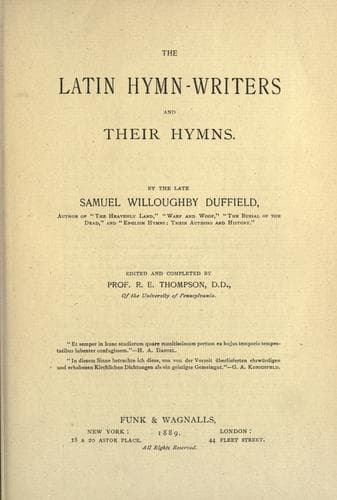
The Latin Hymn-writers and Their HymnsDuffield, Samuel Willoughby
Religion
The Latin Hymn-writers and Their Hymns
Duffield, Samuel Willoughby
Hymns, Latin -- History and criticism
When they reached the Emperor they asked, or rather demanded, that he
should assent to the letter of Pope Leo, who was the first to claim this
submission from the East. They insisted, furthermore, that this
heterodox monarch should accept the definitions of the famous Council of
Chalcedon, A.D. 451, which relate to the nature and personality of
Christ. The schism between East and West had now lasted for thirty-one
years, and a certain Acacius, Bishop of Constantinople, who had been a
most persistent opponent of the demands of Leo the Great, was still a
thorn in the Roman pontiff’s side.
But Anastasius received the ambassadors with just as proud a spirit as
they had shown to him. He would neither yield to Leo nor to Chalcedon,
nor would he anathematize Acacius. Ennodius and his companions returned
to Rome without accomplishing their mission, and the Emperor sent
letters after them by Theopompus and Severianus, principal men of his
court. When these reached Rome they were badly received by Hormisdas,
and found that nothing would answer except the excommunication of
Acacius. With this _ultimatum_ they got back, somewhat crestfallen; and
poor Acacius (who was not half so bad as his papal foe) was once more
threatened with banishment to eternal fires.
Anastasius, however, was not at all inclined to hand over his bishop to
the mercies of Hormisdas. He stoutly refused and continued to refuse
throughout the ensuing correspondence. About two hundred monks and
archimandrites (heads of monasteries) sent from Syria a letter to the
Pope which was directed against the patriarch of Antioch, Severus by
name, and which gave in their own allegiance to the Western Church.
Nevertheless, the Emperor still maintained the cause of Acacius,
although he must have seen that the Pope was as determined as ever to
carry his point and that there was now a great deal which was working in
favor of the papal plans. When the Syrians addressed their letter to the
“Most holy and blessed Hormisdas, Patriarch of the whole earth, holding
the see of Peter the prince of the apostles,” it spoke volumes for what
the Pope had been able to effect by his agents and representations in
the East. But the Emperor would not yield the point and act upon the
conciliatory policy of the heretical Theodoric of Italy, which was that
they might settle religious matters in their own fashion, provided they
honored absolutely his temporal sway.
Public-domain text, read in full here on John Shaqi.
Reviews
Reviews
No reviews yet
Be the first to share your thoughts on this work.
Elsewhere in the archive
Join the Discussion
Join the discussion
Sign in to leave a comment or review.
Sign InorCreate an account