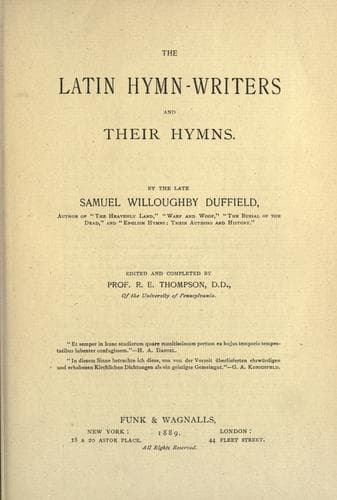
The Latin Hymn-writers and Their HymnsDuffield, Samuel Willoughby
Religion
The Latin Hymn-writers and Their Hymns
Duffield, Samuel Willoughby
Hymns, Latin -- History and criticism
Of the writings which he has left to us, the principal are the life of
Epiphanius; another of Antonius of Pannonia, a hermit at Lake Como and
then a monk at Lerins; together with a _Eucharisticum de Vita sua_ and
the apology and panegyric mentioned above. Add to these nine books of
letters, “weighed down with emptiness,” and various itineraries,
declamations, and poetical pieces, and you have all he did. The letters
are most unsatisfactory when we remember that he was the friend, and
perhaps the relative, of men like Boethius, Faustus, Avienus, Caesar of
Arles, Aurelian, and of bishops and other prelates without number, and
lived in Italy under the great Theodoric. He is utterly lacking in
contemporary portraits, and his accounts of his three journeys give us
nothing valuable. All is stilted, unnatural, and dull. He was not much
of a traveller at best. A trip into Burgundy, another across the Po to
see his sister, and one from Rome by sea, make up the list of which he
kept any trace in his writings. He is in no haste to detail the sayings
and doings at Constantinople! But it should be said that these
performances with the pen were previous to his elevation to the mitre.
Afterward he doubtless composed only hymns and epigrams—the hymns being
decent and the epigrams very much the reverse. The German scholar
Teuffel looks upon his productions as an “important source of history”
for some enigmatic reason of his own, but Simcox very justly scouts
them; and the Romanist Berington asserts that he rises “with weariness”
from their perusal. I must personally declare that they exhibit neither
skill, taste, nor information. They are jejune and empty to a marvellous
degree; and for complication of sentences and unclassical phraseology,
they are equal to the stupidest books of a later day. And nothing worse
than this can be said by any critic.
The _Eucharisticum_ is an insincere sort of thanksgiving for his
restoration to health, and very far behind the style of Augustine which
it copies. It gives us a few particulars of his personal history, but it
is prosaic and Pharisaic, and full of a mock humble glorification of the
blessed Victor the Martyr, by whose intercession he is now convalescent.
The hymns are a trifle more hopeful, and really merit our notice. They
are by no means the “dozen tame hymns” of which Simcox speaks so
contemptuously. There are sixteen of them and three are quite good.
Here, for instance, is the _Christe lumen perpetuum_:
“O Christ, the eternal light
Of every sun and sphere,
Illumine thou our mortal night
And keep our spirits clear.
“Let nothing evil smite,
Nor enemy invade;
And let us stainless be, and white,
By nothing base betrayed.
“Guard thou the hearts of all,
But chiefly of thine own;
And hold us, that we may not fall,
Through thy great might alone.
“That so our souls may sing,
When favoring light they see;
And every vow and tribute bring
To God in Trinity.”
Public-domain text, read in full here on John Shaqi.
Reviews
Reviews
No reviews yet
Be the first to share your thoughts on this work.
Elsewhere in the archive
Join the Discussion
Join the discussion
Sign in to leave a comment or review.
Sign InorCreate an account