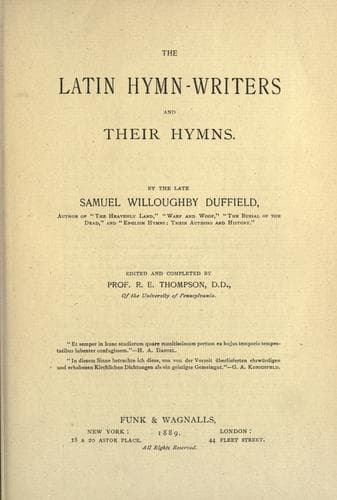
The Latin Hymn-writers and Their HymnsDuffield, Samuel Willoughby
Religion
The Latin Hymn-writers and Their Hymns
Duffield, Samuel Willoughby
Hymns, Latin -- History and criticism
The _Christe precamur_ is quite as good:
“To thee O Christ we ever pray
And blend our prayer with tears;
Thou pure and holy One, alway
Protect our night of years!
“Our hearts shall be at rest in thee;
In sleep they dream thy praise,
And to thy glory, faithfully,
They hail the coming days.
“Give us a life that shall not fail;
Refresh our spirits then;
Let blackest night before thee pale,
And bring thy light to men!
“Our vows in song we pay thee still,
And, at the evening hour,
May all that we have purposed ill
Be right through sovereign power!”
There is yet one more hymn which seems worthy of a place in our regard.
It is the _Christe salvator omnium_:
“O Christ, the Saviour of all,
Thou Lord of the heavens above;
We ask thy glorious aid
Before the day shall remove.
“The sun is hastening down;
His light is sunk in the west;
He hideth the world in gloom,
According to God’s behest.
“Do thou, most excellent Lord,
As we thy followers pray,
To us, all weary with toil,
Grant quiet night on our way.
“That day, from our darkening hearts,
May never withdraw her light;
But, safe in thy guardian grace,
Thy love illumine our night.”
The poetical and spiritual range of these lyrics is not extensive, of
course, but it is a vast improvement on those “uncleanly imitations of
Martial,” or such involved and heartless tricks of verse as he sometimes
essays. But he became a saint, and that must suffice! His life has been
written by Sirmond; and his times and life together have occupied the
attention of Fertig (Passau, 1855). He died at Padua, as we are credibly
informed, on July 17th (XVI. Kal. Aug.), 521, and this date is assigned
to him in the Roman Catholic calendar of saints. His epitaph, according
to Despont, who wrote in 1677, was still to be found in the church of
St. Michael, and testimonies to his services are among the acts of the
Fifth Synod of Rome, and are included in the public papers of Hormisdas.
When you break open the important historical facts with which he was
identified, then like the toad from the stone, comes forth Ennodius. And
like that toad, though “ugly and venomous,” he yet “wears a precious
jewel in his head.”
CHAPTER VIII.
CAELIUS SEDULIUS AND HIS ALPHABET HYMN.
Public-domain text, read in full here on John Shaqi.
Reviews
Reviews
No reviews yet
Be the first to share your thoughts on this work.
Elsewhere in the archive
Join the Discussion
Join the discussion
Sign in to leave a comment or review.
Sign InorCreate an account