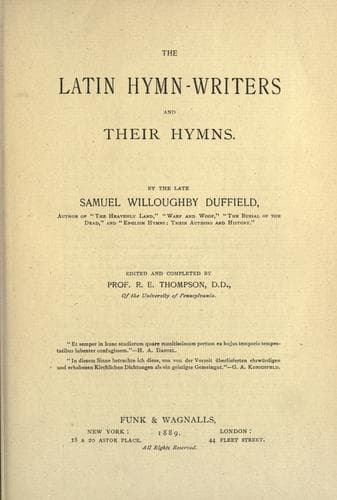
The Latin Hymn-writers and Their HymnsDuffield, Samuel Willoughby
Religion
The Latin Hymn-writers and Their Hymns
Duffield, Samuel Willoughby
Hymns, Latin -- History and criticism
It was, he said, a matter of great surprise to him that no one had done
for the Latin hymn-writers what had been done for those of later date.
We had their hymns, but for his part he confessed to a love for the
personality of the poets themselves, and for the circumstances which
conspired to produce their poems. Now, if it seemed good to myself, who
had already given time and study to the hymns, he would gladly open the
columns of the _Christian Intelligencer_ (the organ of the Reformed
Church in America) to a series of articles bearing such a character. And
there and then the book began.
But my original ideas modified greatly as I went on. In place of my
mastering the subject, the subject mastered me. My previous studies went
for but very little, and my confidence in my ability to prepare the
articles without taking much time from regular and important duties
diminished with every number. I found myself on new ground and was
perpetually referred back to the original authorities. French and German
and Latin—I had to investigate them all in order to satisfy that
insatiate creature, a scholar’s conscience. I discovered that, except
for rare and slight notices, this sort of work had neither been done nor
was likely to be done, and conferences with our best hymnologists only
made me more interested in doing it, and doing it as well as I could.
Doubtless those whose specialities lie in mediaeval days will find much
to criticise, but no one can be a severer critic than myself according
to my means of information.
These chapters, like this Introduction, will be found to be written in
the American language. Their purpose is to reach the popular desire for
better knowledge, and it would be absurd to offer these facts in any dry
or pedantic style. Yet the scholar and the hymnologist will both find
that a positive value and a careful accuracy attach to the work that has
been done. I found I could take nothing for granted, and I took nothing
for granted. Even the Archbishop of Dublin and the principal of
Sackville College have their idiosyncrasies and predilections, and a
quite easy way of writing on these topics is to copy what has been said
already. A very notable case to the contrary is Lord Selborne’s splendid
article on “Hymns” in the new _Encyclopaedia Britannica_.
Therefore life and song and color are not absent, I trust, from these
pages. I should not like to give all the authorities consulted or
rummaged through; for, indeed, I have kept no record of them. Like the
famous sun-dial I have registered none but the serene hours, and many a
time the scarce and long-sought volume before me has been jejune enough.
While, on the other hand, a book like Morison’s _Life of St. Bernard_
has turned out to be precisely the help I was seeking, bright in its
style and careful and original in its researches. I have verified its
quotations too often not to pay it at least this faint tribute of
approval.
Public-domain text, read in full here on John Shaqi.
Reviews
Reviews
No reviews yet
Be the first to share your thoughts on this work.
Join the Discussion
Join the discussion
Sign in to leave a comment or review.
Sign InorCreate an account