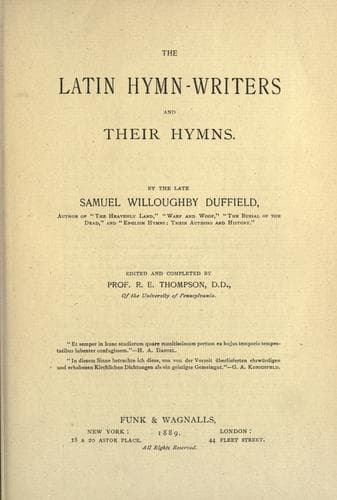
The Latin Hymn-writers and Their HymnsDuffield, Samuel Willoughby
Religion
The Latin Hymn-writers and Their Hymns
Duffield, Samuel Willoughby
Hymns, Latin -- History and criticism
Into such an order as this—an order of which he was to be one of the
most illustrious lights—a divine impulse was pressing Gregory. He grew
more closely attached to the Benedictines of Monte Cassino. His
religious relatives encouraged his evident zeal. And thus after
vibrating like a bee between the odorous rose and the honey-giving
clover, he settled upon the humbler and sweeter flower and let the world
go by.
The Arian Lombards had encamped upon that region which we after their
name now call Lombardy. The Roman bishops were already the prop of the
heathen state against the semi-Christian invaders; but with Lombards,
and those whose religion was only a fiction, their influence was
deplorably slight. Yet as Christianity increased, according to George
Herbert’s simile,
“Like to those trees whom shaking fastens more,”
the Church became doubly influential through the skill of Gregory. He
felt religion to be the source of the truest strength and thus he turned
his wealth and his life into its treasury.
In the year 575 he took his great revenues and endowed six new
monasteries in Sicily. Then he established a seventh, devoting it to the
honor of St. Andrew; and this was at Rome, in his own palace on the
Coelian hill. The populace who had seen him in silk and jewels now
beheld him, a poor monk of the Benedictine Order, serving the beggars at
the gate. In humility of demeanor and in simplicity of food he became a
model to his fellow-monks. He attended the sick in his new hospital. He
ate only the dried corn, or pulse, which his mother sent to him already
moistened in a silver bowl. This bowl or porringer was the only relic of
his departed splendor, and we are told that he did not keep even this,
but gave it at last to a shipwrecked sailor for whom he had no money,
and who begged importunately from him when he was writing in his cell.
The intensity of his devotion led him into great austerities of fasting
and prayer and study of the Scriptures. He outdid the others in his
abstinence from food and ended by ruining his health, so that he entered
the papacy with a broken constitution. When he most needed the support
of a vigorous body it was therefore denied to him.
The history of his gradual elevation is suggestive. Pope Benedict I.
made him one of the seven cardinal deacons, and gave him charge of one
of the seven principal divisions of the city. Pelagius II. chose him to
head an embassy to Constantinople in 578 to congratulate Tiberius on his
accession to the throne. For six years he remained abroad on this and
similar service, and returned to Rome to be elected abbot of St.
Andrew’s monastery. Here he was perfectly happy. In his _Dialogues_ he
speaks of the serene life and death of several of his brethren, and his
latest biographer (Rev. J. Barmby) is never tired of relating how the
great Pope perpetually looked back with regretful love to those quiet
and happy days of peace with God and man.
Public-domain text, read in full here on John Shaqi.
Reviews
Reviews
No reviews yet
Be the first to share your thoughts on this work.
Elsewhere in the archive
Join the Discussion
Join the discussion
Sign in to leave a comment or review.
Sign InorCreate an account