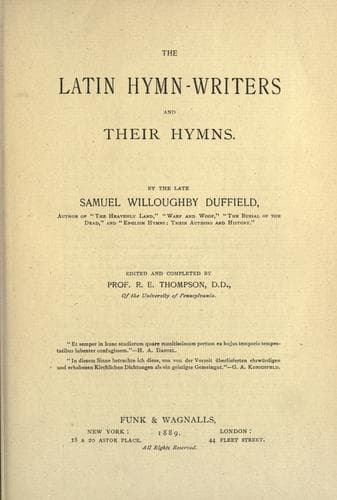
The Latin Hymn-writers and Their HymnsDuffield, Samuel Willoughby
Religion
The Latin Hymn-writers and Their Hymns
Duffield, Samuel Willoughby
Hymns, Latin -- History and criticism
At this period of his life his love for display was as remarkable as his
subsequent simplicity. He delighted in rich attire and surrounded
himself with the pomp and circumstance of his position. A rich man and a
rich man’s son, he was thoroughly in sympathy with passing affairs, and
as Rome bloomed the more vigorously above her own decay, he was himself
one of those “flowers of evil” whose gaudy hues brightened the scene.
But at the same time he became accustomed to the management of large
affairs, and his administration secured to him the good will of his
associates and subordinates. It can often be noticed that these early
Fathers came to their power in the Church after having been strictly and
carefully trained in the world. Hilary and Ambrose were as conspicuous
examples of this foreordination as was Gregory the Great.
Not long previous to this time—for it had been about the year of
Gregory’s birth—Benedict had reformed the monastic order. His work, to
put it briefly, consisted in guarding the entrance to monasticism and in
regulating the hours, habits, and customs of those celibates who
professed such a vocation for the religious life. From his wise and
systematic arrangements, which have been but little improved upon though
often reinforced by “reformations,” monasticism derived that adaptation
to the active and practical life of the West, which it had lacked in the
preceding centuries. Indeed, he so far reacted against the contemplative
idleness of the East, as to aim rather at an industrial than a learned
order. But his successors corrected this defect, and gave the order the
literary and educational character which has been its greatest claim to
the gratitude of Christendom. Thus it came to be that the Benedictine
Fathers became the order of scholars, the editors of the Fathers, of the
_Acta Sanctorum_, and of the _Histoire Litteraire de France_. The
permanent revenues, the fixity and quiet of these monastic lives, the
slow coral-building of these unknown workers, have resulted in gathering
for us all that the mediaeval historian can desire upon the religious
side. And it is here that, delving amid the dust of these mountainous
masses of literature, the student of Latin hymnology will find his
rarest delight. For these acute scholars have literally picked up and
printed, yea, and what is more to the purpose, they have indexed and
classified—whatever he can wish in the way of productions in prose and
verse by any known author. The old MSS. are strained through into
readable type. Their contents are sorted and sifted. And he who pores
over these pages will rise from them at length with a profound
conviction that the scholarship of the Latin Church, and particularly
the Benedictine Order, deserves well from the world of letters and
merits the admiration of the Church Universal.
Public-domain text, read in full here on John Shaqi.
Reviews
Reviews
No reviews yet
Be the first to share your thoughts on this work.
Elsewhere in the archive
Join the Discussion
Join the discussion
Sign in to leave a comment or review.
Sign InorCreate an account