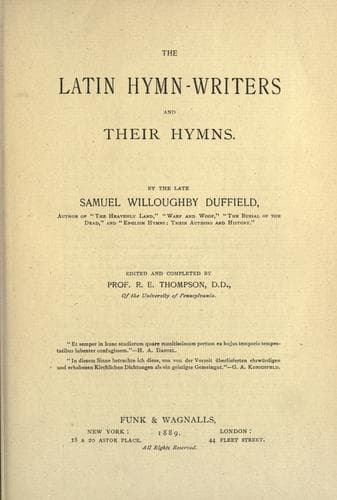
The Latin Hymn-writers and Their HymnsDuffield, Samuel Willoughby
Religion
The Latin Hymn-writers and Their Hymns
Duffield, Samuel Willoughby
Hymns, Latin -- History and criticism
Yet it would be unfair to rob Gregory and Augustine of the honor of
having begun the work, and begun it on a higher and more permanent level
than was possible to the Irish Church. After all, Rome stood for a wider
conception of Church and social order and a broader Christian culture.
It is to her victory that we owe Bede and the great Churchmen, who
adapted the learning and lore of the Latin world to the needs of English
Christendom. And so in Augustine’s mission we may see the apostolic
succession, in a broader sense of the word than the technical, carried
to England, to be transmitted in turn to America. England acknowledged
the gift in the establishment of the tax called “Peter’s Pence” for the
care and support of pilgrims to Rome, and the support of clerics, who
went to study in the Saxon school established in Rome. To this we may
trace, perhaps, the spread of hymn-writing from Rome to England, whose
results are gathered into the Missals and Breviaries of Sarum, York, and
Hereford, and that elaborate compilation, “The Hymns of the Anglo-Saxon
Church,” which Rev. J. Stevenson edited for the Surtees Society.
The mission of Augustine led to far-reaching consequences. One was that
the higher classes of Great Britain turned toward Rome as the centre of
the world, and one of the remoter consequences of this missionary
expedition was the recognition of the papal supremacy. But in his
highest flight of authority Gregory the First never assumed nor felt the
consciousness of power which caused Gregory the Second to write to Leo,
the Isaurian: “All the lands of the West have their eyes directed upon
our humility; by them we are considered as a God upon earth.” No, nor
did he press his claims as did his other successor, Gregory VII., some
times known as Hildebrand.
Indeed, Gregory I. in his desire to save these beautiful captives
offered himself to Pope Pelagius as a missionary, and even obtained his
consent to the expedition. But we are informed that the people
surrounded the pontiff on his way to St. Peter’s and begged him to
recall their favorite. So that Gregory had gone but three days’ journey
before he was overtaken and brought back, almost forcibly, to his
monastic home. The scheme of saving Britain was thus deferred but not
given up; and when the cardinal-deacon became Pope it was again revived,
and with success.
Public-domain text, read in full here on John Shaqi.
Reviews
Reviews
No reviews yet
Be the first to share your thoughts on this work.
Elsewhere in the archive
Join the Discussion
Join the discussion
Sign in to leave a comment or review.
Sign InorCreate an account