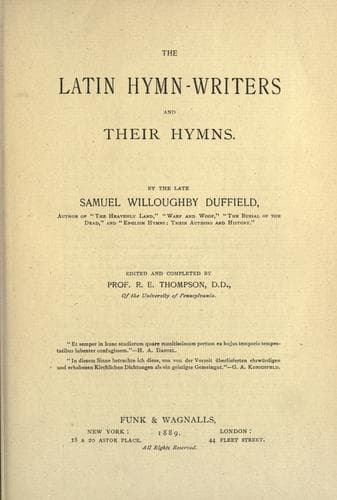
The Latin Hymn-writers and Their HymnsDuffield, Samuel Willoughby
Religion
The Latin Hymn-writers and Their Hymns
Duffield, Samuel Willoughby
Hymns, Latin -- History and criticism
In the year 590 Pelagius II. died of the plague. His chair was no sooner
empty than Gregory was seen to be the choice of everyone—senate and
people and clergy. He was accordingly elected, and then—for such was the
feeling in those days—he resisted the honor with all his might. Like
Ambrose he fled from the city; he disguised himself; he even wandered in
the woods. But it was one of the old principles that the more the elect
refused the more their calling and election were to be made sure to
them. And therefore, he was found at last, after a thorough search, and
was led, literally in tears, back to Rome. He had begged the Emperor
Maurice not to confirm this appointment, but it was to no effect that he
pleaded for release. His quiet, peaceful days were over, and he was
placed at the helm of the ship of the Church to steer her, and the
commonwealth which was her freight, through floods of barbarians and
into safer seas. I am using his own figure: “I am so beaten by the waves
of this world,” he wrote, to his friend Leander, “that I despair of
being able to guide to port this rotten old vessel with which God has
charged me. I weep when I recall the peaceful shore which I have left
and sigh in perceiving afar what I cannot now attain.”
He took his seat in the midst of the plague. Eighty persons in the
processions which he organized at seven points in the city to pray at
the church of Santa Maria-Maggiore for its cessation, died of the
disease during their very progress. Each procession met the others at
this church of St. Mary. One consisted of secular clergy; another of
abbots and monks; a third of abbesses and nuns; a fourth of children; a
fifth of laymen; a sixth of widows, and a seventh of matrons. And thus
arose the story about the angel whom Gregory believed that he saw above
the summit of the Mole of Hadrian, and who there stood and sheathed his
sword. This legend gave to that structure the name of the Castello di
San Angelo, the Castle of the Holy Angel.
The Lombards were Gregory’s first care. He corresponded with
Theodolinda, their queen, and she became his constant friend and his
advocate with the king. He finally obtained from King Agilulf (her
second husband) a special truce for Rome and its neighboring territory—a
most delightful relief from the terrors of the last thirty years.
Public-domain text, read in full here on John Shaqi.
Reviews
Reviews
No reviews yet
Be the first to share your thoughts on this work.
Elsewhere in the archive
Join the Discussion
Join the discussion
Sign in to leave a comment or review.
Sign InorCreate an account