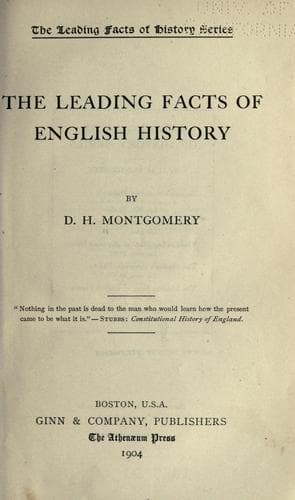
The Leading Facts of English HistoryMontgomery, D. H. (David Henry)
History
The Leading Facts of English History
Montgomery, D. H. (David Henry)
Great Britain -- History
Henry went back in triumph to England. Two years later, he again
invaded France. His victorious course continued. By the Treaty of
Troyes (1420) he gained all that he had planned to get. He obtained
large sums of money, the French Princess Catharine in marriage, and
the promise of the crown of France on the death of her father, Charles
VI, who was then insane and feeble. Meantime Henry was to govern the
French kingdom as regent.
Henry returned to England with the bride he had won by the sword, but
he was soon recalled to France by a revolt against his power. He died
there, leaving an infant son, Henry. Two months afterward Charles VI
died, so that by the terms of the treaty Henry's son now inherited the
French Crown.
291. Summary.
The one great event with which Henry V's name is connected is the
conquest of France. It was hailed at the time as a glorious
achievement. In honor of it his tomb in Westminster Abbey was
surmounted by a statue of the King, having a head of solid silver.
Eventually the head was stolen and never recovered; the wooden statue
still remains. The theft was typical of Henry's short-lived victories
abroad, for all the territory he had gained was soon destined to be
hopelessly lost.
Henry VI (House of Lancaster, Red Rose)--1422-1461
292. Accession of Henry; Renewal of the French War.
The heir to all the vast dominions left by Henry V was proclaimed King
of England and France when in his cradle, and crowned, while still a
child, first in Westminster Abbey and then at Paris.
But the accession to the French possesions was merely an empty form,
for as Prince Charles, the son of the late Charles VI of France,
refused to abide by the Treaty of Troyes (S290) and give up the
throne, war again broke out.
293. Siege of Orleans.
The Duke of Bedford[1] fought vigorously in Henry's behalf. In five
years the English had got possession of most of the country north of
the Loire. They now determined to make an effort to drive the French
Prince south of that river. To accomplish this they must take the
strongly fortified town of Orleans, which was situated on its banks.
(See map facing p. 84.)
[1] During Henry's minority, John, Duke of Bedford, was Protector of
the realm. When absent in France, Humphrey, Duke of Gloucester, acted
for him.
Forts were accordingly built around the place, and cannon planted to
batter down its walls (S239). Six month later, so much progress had
been made in the siege, that it was plain the city could not hold out
much longer. The fortunes of Prince Charles seemed to depend on the
fate of Orleans. If it fell, nothing, apparently, could save France
from yielding to her conqueror.
294. Joan of Arc, 1429-1431.
Public-domain text, read in full here on John Shaqi.
Reviews
Reviews
No reviews yet
Be the first to share your thoughts on this work.
Elsewhere in the archive
Join the Discussion
Join the discussion
Sign in to leave a comment or review.
Sign InorCreate an account