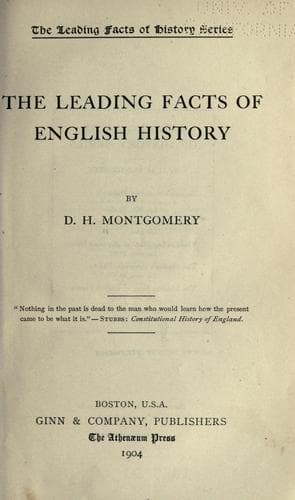
The Leading Facts of English HistoryMontgomery, D. H. (David Henry)
History
The Leading Facts of English History
Montgomery, D. H. (David Henry)
Great Britain -- History
At this juncture Joan of Arc, a peasant girl of eighteen, came forward
to inspire her despairing countrymen with fresh courage. She believed
that Heaven had called her to drive the English from the land. The
troops rallied round her. Clad in white armor, mounted on a white war
horse, she saved Orleans; then she led the troops from victory to
victory, until she saw Prince Charles triumphantly crowned in the
Cathedral of Rheims. (See map facing p. 128.)
Her fortunes soon changed. Her own people basely abandoned her. The
unworthy King Charles made no attempt to protect the "Maid of
Orleans," and she fell into the hands of the infuriated English, who
believed she was in league with the devil. In accordance with this
belief Joan was tried for witchcraft and heresy at Rouen, and
sentenced to the flames. She died (1431) as bravely as she had
lived, saying in her last agonies that her celestial voices had not
deceived her, and that through them she had saved France.
"God forgive us," exclaimed one of Henry's courtiers who was present,
"we are lost! We have burned a saint!" It was the truth; and from the
martyred girl's ashes a new spirit seemed to go forth to bless her
ungrateful country. The heart of the French people was touched; they
rose and drove the English invaders from the soil of France.
Before Henry VI reached his thirtieth year the Hundred Years' War with
France, which Edward III had begun (S237), was ended (1453), and
England had lost all of her possessions on the Continent, except a
bare foothold at Calais, and that was destined to be lost a few
generations later (S373).
295. Henry VI's Character and Marriage.
When Henry became of age he proved to be but the shadow of a King.
His health and character were alike feeble. At twenty-five he married
the beautiful and unfortunate French Princess, Margaret of Anjou, who
was by far the better man of the two. When years of disaster came,
this dauntless "Queen of tears" headed councils, led armies, and ruled
both King and kingdom.
296. Poverty of the Crown and Wealth of the Nobles.
One cause of the weakness of the government was its poverty. The
revenues of the Crown had been greatly diminished by gifts and grants
to favorites. The King was obliged to pawn his jewels and the silver
plate from his table to pay his wedding expenses; and it is said on
high authority[1] that the royal couple were sometimes in actual want
of a dinner.
[1] Fortescue, on the "Government of England" (Plummer).
On the other hand, the Earl of Warwick and other great lords had made
fortunes out of the French wars,[2] and lived in regal splendor. This
Earl, it is said, had at his different castles and his city mansion in
London upwards of thirty thousand men in his service. Their livery,
or uniform, a bright red jacket with the Warwick arms--a bear erect
holding a ragged staff--embroidered on it in white, was seen, known,
and feared throughout the country.
Public-domain text, read in full here on John Shaqi.
Reviews
Reviews
No reviews yet
Be the first to share your thoughts on this work.
Elsewhere in the archive
Join the Discussion
Join the discussion
Sign in to leave a comment or review.
Sign InorCreate an account