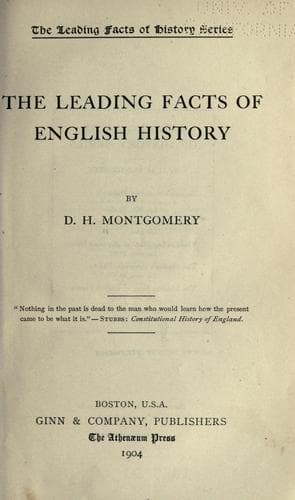
The Leading Facts of English HistoryMontgomery, D. H. (David Henry)
History
The Leading Facts of English History
Montgomery, D. H. (David Henry)
Great Britain -- History
[2] First, by furnishing troops to the government, the feudal system
having now so far decayed that many soldiers had to be hired;
secondly, by the plunder of French cities; thirdly, by ransoms
obtained from noblemen taken prisoners.
Backed by such forces it was easy for the Earl and other powerful
lords to overawe kings, parliaments, and courts. Between the heads of
the great houses quarrels were constantly breaking out. The safety of
the people was endanged by these feuds, which became more and more
violent, and often ended in bloodshed and murer.
297. Disfranchisement of the Common People, 1430.
With the growth of power on the part of the nobles, there was also
imposed for the first time a restriction on the right of the people to
vote for members of Parliament. Up to this period all freemen might
take part in the election of representatives chosen by the counties to
sit in the House of Commons.
A law was now passed forbidding any one to vote at these elections
unless he was a resident of the county and possessed of landed
property yielding an annual income of forty shillings (S200).[1]
Subsequently it was further enacted that no county candidate should be
eligible unless he was a man of means and social standing.
[1] The income required by the statute was forty shillings, which,
says Freeman, we may fairly call forty pounds of our present money.
See E.A. Freeman's "Growth of the English Constitution," p. 97.
These two measures were blows against the free self-government of the
nation, since their manifest tendency was to make the House of Commons
represent the property rather than the people of the country (S319).
(See, too, Summary of Constitutional History in the Appendix, p. xiii,
S14.)
298. Cade's Rebellion (1450).
A formidable rebellion broke out in Kent (1450), then, as now, one of
the most independent and democratic counties in England. The leader
was Jack Cade, who called himself by the popular name of Mortimer
(S257, note 1, and S279). He claimed to be cousin to Richard, Duke of
York, a nephew of that Edmund Mortimer, now dead, whom Henry IV had
unjustly deprived of his succession to the crown.
Cade, who was a mere adventurer, was quite likely used as a tool by
plotters much higher than himself. By putting him forward they could
judge whether the country was ready for a revolution and change of
sovereigns.
Wat Tyler's rebellion, seventy years before (S250), was almost purely
social in its character, having for its object the emancipation of the
enslaved laboring classes. Cade's insurrection was, on the contrary,
almost wholly political. His chief complaint was that the people were
not allowed their free choice in the election of representatives, but
were forced by the nobility to choose candidates they did not want.
Other grievances for which reform was demanded were excessive
taxastion and the rapacity of the evil counselors who controlled the
King.
Public-domain text, read in full here on John Shaqi.
Reviews
Reviews
No reviews yet
Be the first to share your thoughts on this work.
Elsewhere in the archive
Join the Discussion
Join the discussion
Sign in to leave a comment or review.
Sign InorCreate an account