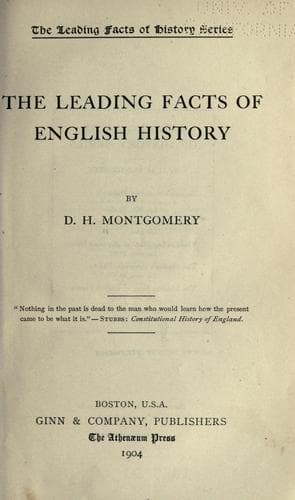
The Leading Facts of English HistoryMontgomery, D. H. (David Henry)
History
The Leading Facts of English History
Montgomery, D. H. (David Henry)
Great Britain -- History
When the Tudors came to the throne, England was still full of rankling
hate engendered by the Wars of the Roses (S299). Held down by the
heavy hand of Henry VII, and later, by the still heavier one of Henry
VIII, the country learned the same salutary lesson of growth under
repression which had benefited Spain and France.
Henceforth Englishmen of all classes no longer boasted that they
belonged to the Yorkist or the Lancastrian faction (S300), but began
to pride themselves on their loyalty to Crown and country, and their
readiness to draw their swords to defend both.[1]
[1] But the passage of Poyning's Act (1494) in Ireland prohibited the
Irish Parliament from passing any law which did not receive the
sanction of the English Council. This act was not repealed until
1782.
330. Henry's Methods of raising Money; the Court of Star Chamber.
Henry's reign was in the interest of the middle classes,--the farmers,
tradesmen, and mechanics. His policy was to avoid heavy taxation, to
exempt the poor from the burdens of state, and so ingratiate himself
with a large body of the people.
In order to accomplish this, he revived "benevolences" (SS307, 313),
and by a device suggested by his chief minister, Cardinal Morton, and
hence known and dreaded as "Morton's Fork," he extorted large sums
from the rich and well-to-do.[2]
[2] Those whose income from land was less than $2, or whose movable
property did not exceed 15 pounds (Say 150 pounds and $1125 now), were
exempt. The lowest rate of assessment for the "benevolences" was
fixed at twenty pence on the pound on land, and half that rate on
other property.
The Cardinal's agents made it their business to learn every man's
income, and visit him accordingly. If a person lived handomely, the
Cardinal would insist on a correspondingly liberal gift; if, however,
a citizen lived very plainly, the King's minister insisted none the
less, telling the unfortunate man that by his economy he must surely
have accumulated enough to bestow the required "benevolence."[3] Thus
on one prong or the other of his terrible "fork" the shrewd Cardinal
impaled his writhing victims, and speedily filled the royal treasury
as it had never been filled before.[4]
[3] Richard Reed, a London alderman, refused to contribute a
"benevolence." He was sent to serve as a soldier in the Scotch wars
at his own expense, and the general was ordered to "use him in all
things according to sharp military discipline." The effect was such
that few after that ventured to deny the King what he asked.
[4] Henry is said to have accumulated a fortune of nearly two millions
sterling, an amount which would perhaps represent upwards of
$90,000,000 now.
Public-domain text, read in full here on John Shaqi.
Reviews
Reviews
No reviews yet
Be the first to share your thoughts on this work.
Elsewhere in the archive
Join the Discussion
Join the discussion
Sign in to leave a comment or review.
Sign InorCreate an account