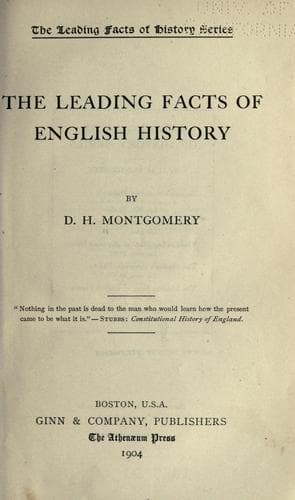
The Leading Facts of English HistoryMontgomery, D. H. (David Henry)
History
The Leading Facts of English History
Montgomery, D. H. (David Henry)
Great Britain -- History
But Henry VII had other methods for raising money. He sold offices in
Church and State, and took bribes for pardoning rebels. When he
summoned a Parliament he obtained grants for putting down some real or
pretended insurrection, or to defray the expenses of a threatened
attack from abroad, and then quietly pocketed the appropriation,--a
device not altogether unknown to modern government officials.
A third and last method for getting funds was invented in Henry's
behalf by two lawyers, Empson and Dudley, who were so rapacious and
cut so close that they were commonly known as "the King's skin
shearers." They went about the country enforcing old and forgotten
laws, by which they reaped a rich harvest.
Their chief instrument for gain, however, was a revival of the Statute
of Liveries. This law imposed enormous fines on those noblemen who
dared to equip their followers in military garb, or designate them by
a badge equivalent to it, as had been the custom during the late civil
wars (S296).
In order to thoroughly enforce the Statute of Liveries, Henry
organized the Court of Star Chamber, so called from the starred
ceiling where the tribunal met. This court had for its object the
punishment of such crimes committed by the great families, or their
adherents, as the ordinary law courts could not, or through
intimidation dared not, deal with. It had no power to inflict death,
but might impose long terms of imprisonment and ruinous fines. It,
too, first made use of torture in England to extort confessions of
guilt.
Henry seemed to have enforced the Law of Livery against friend and foe
alike. Said the King to the Earl of Oxford, as he left his castle,
where a large number of retainers in uniform were drawn up to do him
honor, "My lord, I thank you for your entertainment, but my attorney
must speak to you." The attorney, who was the notorious Empson,
brought suit in the Star Chamber against the Earl, who was fined
fifteen thousand marks, or something like $750,000, for the incautious
display he had made.
331. The Introduction of Artillery strengthens the Power of the King.
It was easier for Henry to pursue this arbitrary course because the
introduction of artillery had changed the art of war. Throughout the
Middle Ages the call of a great baron had, as Macaulay says, been
sufficient to raise a formidable revolt. Countrymen and followers
took down their tough yew long bows from the chimney corner, knights
buckled on their steel armor, mounted their horses, and in a few days
an army threatened the holder of the throne, who had no troops save
those furnished by loyal subjects.
Public-domain text, read in full here on John Shaqi.
Reviews
Reviews
No reviews yet
Be the first to share your thoughts on this work.
Elsewhere in the archive
Join the Discussion
Join the discussion
Sign in to leave a comment or review.
Sign InorCreate an account