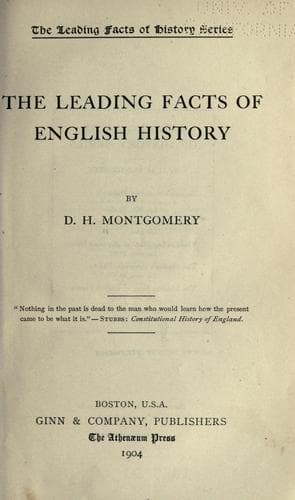
The Leading Facts of English HistoryMontgomery, D. H. (David Henry)
History
The Leading Facts of English History
Montgomery, D. H. (David Henry)
Great Britain -- History
Thus Anne Askew, a young and beautiful woman, was nearly wrenched
asunder on the rack, in the hope of making her implicate the Queen in
her heresy. She was afterward burned because she insisted that the
bread and wine used in the communion service seemed to her to be
simply bread and wine, and not in any sense the actual body and blood
of Christ, as the King's statute of the Six Articles (S357) solemnly
declared.
On the other hand, the aged Countess of Salisbury suffered for
treason; but with a spirit matching the King's, she refused to kneel
at the block, and told the executioner he must get her gray head off
as best he could.
359. Henry's Death.
But the time was at hand when Henry was to cease his hangings,
beheadings, and marriages. Worn out with debauchery, he died at the
age of fifty-six, a loathsome, unwieldy, and helpless mass of
corruption. In his will he left a large sum of money to pay for
perpetual prayers for the repose of his soul. Sir Walter Raleigh said
of him, "If all the pictures and patterns of a merciless prince were
lost in the world, they might all again be painted to the life out of
the story of this king."
It may be well to remember this, and along with it this other saying
of one of the ablest writers on English constitutional history, that
"the world owes some of tis greatest debts to men from whose memory it
recoils."[1] The obligation it is under to Henry VIII is that through
his influence--no matter what the motive--England was lifted up out of
the old medieval ruts, and placed squarely and securely on the new
highway of national progress.
[1] W. Stubbs's "Constitutional History of England."
360. Summary.
In this reign we find that though England lost much of her former
political freedom, yet she gained that order and peace which came from
the iron hand of absolute power. Next, from the destruction of the
monasteries, and the sale or gift of their lands to favorites of the
King, three results ensued:
1. A new nobility was in great measure created, dependent on the
Crown.
2. The House of Lords was made less powerful by the removal of the
abbots who had had seats in it.
3. Pauperism and distress were temporarily increased.
4. Finally, England completely severed her connection with the Pope,
and established for the first time an independent National Church,
having the King as its head.
Edward VI--1547-1553
361. Bad Government; Seizure of Unenclosed Lands; High Rents;
Latimer's Sermon.
Edward, son of Henry VIII by Jane Seymour (S355), died at sixteen. In
the first part of his reign of six years the goverment was managed by
his uncle, the Duke of Somerset, an extreme Protestant, whose
intentions were good, but who lacked practical judgement. During the
latter part of his life Edward fell under the control of the Duke of
Northumberland, who was the head of a band of scheming and profligate
men.
Public-domain text, read in full here on John Shaqi.
Reviews
Reviews
No reviews yet
Be the first to share your thoughts on this work.
Elsewhere in the archive
Join the Discussion
Join the discussion
Sign in to leave a comment or review.
Sign InorCreate an account