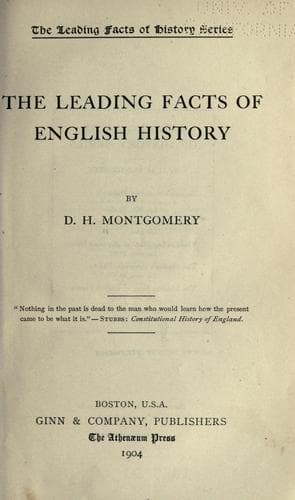
The Leading Facts of English HistoryMontgomery, D. H. (David Henry)
History
The Leading Facts of English History
Montgomery, D. H. (David Henry)
Great Britain -- History
They, with other nobles, seized the unenclosed lands of the country
and fenced them in for sheep pastures, thus driving into beggary many
who had formerly got a good part of their living from these commons.
At the same time farm rents rose in somee cases ten and even twenty
fold,[1] depriving thousands of the means of subsistence, and reducing
to poverty many who had been in comfortable circumstances.
[1] This was oweing to the greed for land on the part of the
mercantile classes, who had now acquired wealth, and wished to become
landed proprietors. See Froude's "England."
The bitter complaints of the sufferers found expression in Bishop
Latimer's outspoken sermon, preached before King Edward, in which he
said: "My father was a yeoman [small farmer], and had no lands of his
own, only he had a farm of three or four pounds [rent] by year, and
hereupon tilled so much as kept half a dozen men; he had walk
[pasture] for a hundred sheep, and my mother milked thirty kine.
"He was able and did find the King a harness [suit of armor] with
himself and his horse, until he came to the place where he should
receive the King's wages. I can remember that I buckled his harness
when he went into Blackheath Field. He kept me to school, or else I
had not been able to have preached before the King's majesty now. He
married my sisters with five pounds [dower] ... apiece. He kept
hospitality for his poor neighbors, and some alms he gave to the poor.
"And all this he did off the said farm, where he that now hath it
payeth sixteen pounds a year or more, and is not able to do anything
for his prince, for himself, nor for his children, or give a cup of
drink to the poor." But as Latimer patheticall said, "Let the
preacher preach till his tongue be worn to the stumps, nothing is
amended."[1]
[1] Latimer's first sermon before King Edward VI, 8th of March, 1549.
362. Edward establishes Protestantism, 1549.
Henry VIII had made the Church of England independent of the Pope
(S349). His son took the next great step, and made it practically
Protestant in doctrine. At his desire, Archbishop Cranmer compiled a
book of Common Prayer in English. It was taken largely from the Roman
Catholic Prayer Book, which was in Latin (1549). The first Act of
Uniformity, 1549 (reenacted 1552), obliged all churches to use the new
English Prayer Book, thereby, (for the time) establishing a modified
form of Protestantism throughout England (S405).[2]
[2] On the Church of England, see Macaulay's "England," I, 40-42.
Edward's sister, the Princess Mary, was a most devout Catholic. She
refused to adopt the new service, saying to Bishop Ridley, who urged
her to accept it as God's word, "I cannot tell what you call God's
word, for that is not God's word now which was God's word in my
father's time." It was at this period (1552) that the Articles of
Religion of the Church of England were first drawn up; but they did
not take their final form until the reign of Elizabeth (S383).
Public-domain text, read in full here on John Shaqi.
Reviews
Reviews
No reviews yet
Be the first to share your thoughts on this work.
Elsewhere in the archive
Join the Discussion
Join the discussion
Sign in to leave a comment or review.
Sign InorCreate an account