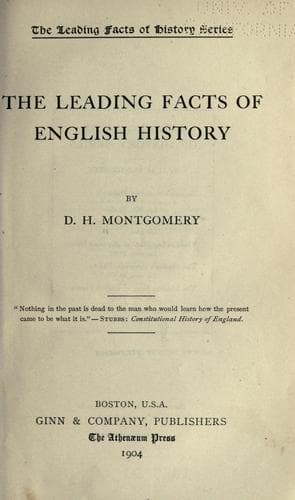
The Leading Facts of English HistoryMontgomery, D. H. (David Henry)
History
The Leading Facts of English History
Montgomery, D. H. (David Henry)
Great Britain -- History
Yet during Cromwell's rule the country, notwithstanding all the
restrictions imposed by a stern military government, grew and
prospered. The English forces gained victories by land and sea, and
made the name of the Protector respected as that of Charles I had
never been.
At this period the carrying trade of the world, by sea, had fallen
into the hands of the Dutch, and Amsterdam had become a more important
center of exchange than London. The Commonwealth passed a measure
called the "Navigation Act"[2] (1651) to encourage British commerce.
It prohibited the importation or exportation of any goods into England
or its colonies in Dutch or other foreign vessels.
[2] The Navigation Act was renewed later. Though aimed at the Dutch,
this measure damaged the export trade of the American colonies for a
time.
Later, war with the Dutch broke out partly on account of questions of
trade, and partly because Royalist plotters found protection in
Holland. Then Cromwell created such a navy as the country had never
before possessed. Under the command of Admiral Blake, "the sea king,"
and Admiral Monk, the Dutch were finally beaten so thoroughly (1653)
that they bound themselves to ever after salute the English flag
wherever they should meet it on the seas. A war undertaken in
alliance with France against Spain was equally successful. Jamaica
was taken as a permanent possession by the British fleet, and France,
in return for Cromwell's assistance, reluctantly gave the town of
Dunkirk to England (1658), and the flag of the English Commonwealth
was planted on the French coast. But a few years later (1662), the
selfish and profligate Charles II sold Dunkirk back to Louis XIV in
order to get money to waste on his pleasures.
460. Cromwell's Death; his Character (1658).
After being King in everything but name for five years, Cromwell died
(September 3, 1658) on the anniversary of the victories of Dunbar and
Worcester (S453). During the latter part of his career he had lived
in constant dread of assassination, and wore concealed armor. At the
hour of his death one of the most fearful storms was raging hat had
ever swept over England. To many it seemed a fit accompaniment to the
close of such a life.
In one sense, Cromwell was a usurper and a tyrant; but, at heart, his
object was his country's welfare. In such cases the motive is all in
all. He was a lonely man of rough exterior and hard manner.[1] He
cared little for the smooth proprieties of life, yet he had that
dignity of bearing which high moral purpose gives. In all that he did
he was eminently practical. In an age of isms, theories, and
experiments, he was never confused and never faltered in his course.
To-day a colossal bronze statue of the great soldier and ruler stands
in the shadow of the Houses of Parliament, where the English people,
more than two hundred and forty years after his burial, voted to erect
it.
Public-domain text, read in full here on John Shaqi.
Reviews
Reviews
No reviews yet
Be the first to share your thoughts on this work.
Elsewhere in the archive
Join the Discussion
Join the discussion
Sign in to leave a comment or review.
Sign InorCreate an account