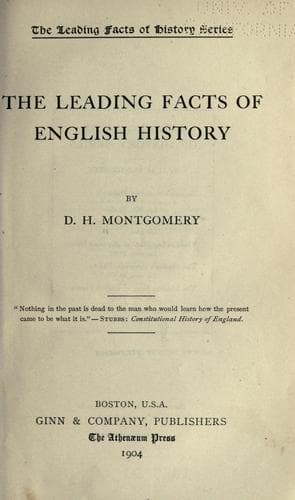
The Leading Facts of English HistoryMontgomery, D. H. (David Henry)
History
The Leading Facts of English History
Montgomery, D. H. (David Henry)
Great Britain -- History
[1] Cromwell was always a lonely man, and had so few real friends that
Walter Scott may have expressed his true feeling when he makes him say
in his novel of "Woodstock": "I would _I_ had any creature, were it
but a dog, that followed me because it loved me, not for what it could
make of me."
461. The Times needed Such a Man.
There are emergencies when an ounce of decision is worth a pound of
deliberation. When the ship is foundering or on fire, or when the
crew have mutinied, it will not avail to sit in the cabin and discuss
how it happened. Something must be done, and that promptly. Cromwell
was the man for such a juncture. He saw clearly that if the country
was to be kept together, it must be by decided measures, which no
precedent, law, or constitution justified, but which stood justified
none the less by exigencies of the crisis, by his own conscious
rectitude of purpose, and by the result.
If there is any truth in Napoleon's maxim, that "The tools belong to
him that can use them," then Cromwell had a God-given right to rule;
for, first, he had the ability; and, next, though he used his power in
his campaign in Ireland (S453) with merciless severity, yet the great
purpose of his life was to establish order and justice on what seemed
to him the only practical basis.
462. Summary.
Cromwell's original object appears to have been to organize a
government representing the will of the nation more completely than it
had ever been represented before. He strongly favored the restoration
of the House of Lords, he endeavored to reform the laws, and he sought
to secure religious toleration for the great body of Protestants. One
who knew Cromwell intimately said, "A larger soul, I think, hath
seldom dwelt in a house of clay, than his was."
Circumstances, however, were often against him; he had many enemies,
and in order to secure peace he was obliged to resort to the exercise
of absolute power. Yet the difference in this respect between
Cromwell and Charles I was immense: the latter was despotic on his own
account, the former for the advantage of those he governed.
RICHARD CROMWELL--September 3, 1658-April 22, 1659
463. Richard Cromwell's Incompetency.
Public-domain text, read in full here on John Shaqi.
Reviews
Reviews
No reviews yet
Be the first to share your thoughts on this work.
Elsewhere in the archive
Join the Discussion
Join the discussion
Sign in to leave a comment or review.
Sign InorCreate an account