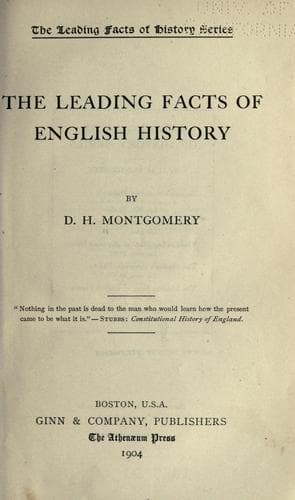
The Leading Facts of English HistoryMontgomery, D. H. (David Henry)
History
The Leading Facts of English History
Montgomery, D. H. (David Henry)
Great Britain -- History
To-day entire harmony exists. Catholics and Protestants "work
together for good" in Parliament, in the Cabinet, in the Courts of
Justice, in the Universities, in the Army and Navy, in the service of
the Press, and in private life.[1]
[1] The names of many eminent Catholics might be cited, such as
Professor Lingard, the historian (1851), the late Lord Chief Justice
Russell, the late Lord Acton, Professor of History at Cambridge, and
the late Sir Francis Burnand, editor of _Punch._
498. Further Benefits of the Revolution.
Foremost in the list of other benefits which England gained by the
Revolution of 1688 should be placed: 1. The Toleration Act already
mentioned (S496), which gave a very large number of people the right
of worshiping God according to the dictates of conscience, and which
was the stepping-stone to later measures that completed the good work
of extending religious liberty in England (SS573, 599).
2. Parliament now established the salutory rule that no money should
be voted to the King except for specific purposes, and it also limited
the royal revenue to a few years' supply instead of granting it for
life, as had been done in the case of Charles II and James. Later the
supply was limited to an annual grant. As the Mutiny Act (S496) made
the army dependent for its existence on the annual meeting and action
of the House of Commons, these two measures practically gave the
people full control of the two great powers,--the purse and the
sword,--which they have ever since retained.
3. Parliament next enacted that judges should hold office not as
heretofore, at his Majesty's pleasure, but during good behavior (or
until the death of the reigning sovereign vacated their commissions).
This took away that dangerous authority of the King over the courts of
justice, which had caused so much oppression and cruelty.
4. But, as Macaulay remarks, of all the reforms produced by the
change of government, perhaps none proved more extensively useful than
the establishment of the liberty of the press. Up to this time no
book or newspaper could be published in England without a license.[2]
In the period of the Commonwealth John Milton, the great Puritan poet,
had earnestly labored to get this severe law repealed, declaring that
"while he who kills a man kills a reasonable creature,...he who
destroys a good book [by refusing to let it appear in print] kills
reason itself."[3] But under James II, Chief Justice Scroggs had
declared it a crime to publish anything whatever concerning the
government, whether true or false, without a license. During that
reign there were only four places in England--namely, London, Oxford,
Cambridge, and York--where any book, pamphlet, or newspaper could be
legally issued, and then only with the sanction of a rigid inspector.
[2] See Summary of Constitutional History in the Appendix, p. xxiii,
S26.
[3] Milton's "Areopagitica," or "Speech for the Liberty of Unlicensed
Printing."
Public-domain text, read in full here on John Shaqi.
Reviews
Reviews
No reviews yet
Be the first to share your thoughts on this work.
Elsewhere in the archive
Join the Discussion
Join the discussion
Sign in to leave a comment or review.
Sign InorCreate an account