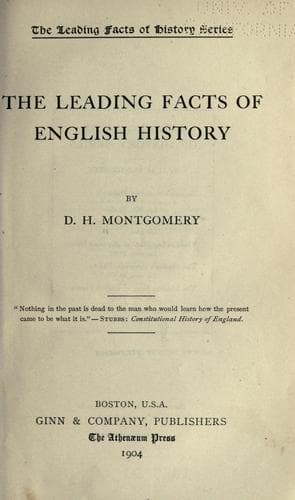
The Leading Facts of English HistoryMontgomery, D. H. (David Henry)
History
The Leading Facts of English History
Montgomery, D. H. (David Henry)
Great Britain -- History
Under William and Mary this restriction was removed. Henceforth men
were free not only to think, but to print and circulate their thought
(subject, of course, to the law of libel and sedition). They could
thus bring the government more directly before that bar of public
opinion which judges all men and all institutions.
499. James II lands in Ireland (1689); Act of Attainder; Siege of
Londonderry.
But though William was King of England, and had been accepted as King
of Scotland, yet the Irish, like the Scotch Highlanders, refused to
recognize him as their lawful sovereign. The great body of Irish
population was then, as now, Roman Catholic. But they had been
gradually dispossessed of their hold on the land (SS159, 402, 453),
and the larger part of the most desirable portion of the island was
owned by a few hundred thousand Protestant colonists.
On the other hand, James II had, during his reign, put the civil
government and the military power in the hands of the Catholics. The
Earl of Tyrconnel (S488) now raised the standard of rebellion in
Ireland in the interest of the Catholics, and invited James II to come
over from France (S491) and regain his throne. The Protestants of the
north stood by William of Orange (S491), and thus got that name of
Orangemen which they have ever since retained. James landed in
Ireland in the spring (1689) with a small French force lent him by
Louis XIV (S491).
He established his headquarters at Dublin. Not long afterwards he
issued that great Act of Attainder (1689) which summoned all who were
in rebellion against his authority to appear for trial on a given day,
or be declared traitors, hanged, drawn, and quartered, and their
property confiscated.[1] Next, the Protestant city of Londonderry
(S423) was bebesieged (1689). For more than three months it held out
against shot and shell, famine and fever.
[1] Attainder (S351): This act contained between two and three
thousand names. It embraced all classes, from half the peerage of
Ireland to tradesmen, women, and children. If they failed to appear,
they could be put to death without trial.
The starving inhabitants, exceeding thirty thousand in number, were
finally reduced to the last extremities. Nothing was left to eat but
a few miserable horses and some salted hides. As they looked into
each other's hollow eyes, the question came, Must we surrender? Then
it was that an aged clergyman, the venerable George Walker, one of the
governors of the city, pleaded with them, Bible in hand, to remain
firm.
That appeal carried the day. They declared that rather than open the
gates to the enemy, they would perish of hunger, or, as some voice
whispered, that they would fall "first on the horses and the
hides,--THEN ON THE PRISONERS,--then--ON EACH OTHER!" But at this
moment, when all hope seemed lost, a shout of triumph was heard. An
English force had sailed up the river, broken through all
obstructions, and the valiant city was saved.
Public-domain text, read in full here on John Shaqi.
Reviews
Reviews
No reviews yet
Be the first to share your thoughts on this work.
Elsewhere in the archive
Join the Discussion
Join the discussion
Sign in to leave a comment or review.
Sign InorCreate an account