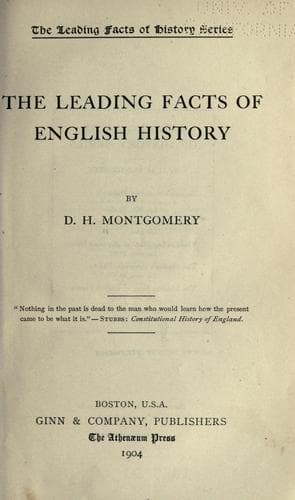
The Leading Facts of English HistoryMontgomery, D. H. (David Henry)
History
The Leading Facts of English History
Montgomery, D. H. (David Henry)
Great Britain -- History
An incident occurred about this time which greatly helped the Tories
(S479) in their schemes. Dr. Sacheverell, a violent Tory and High
Churchman (S507), began preaching a series of vehement sermons in
London condemning the Whig policy which called for the reopening of
the war. He also endeavored to revive the exploding theory of the
Divine Right of Kings (S419, 429), and declared that no tyranny on the
part of a sovereign could by any possibility justify a subject in
resisting the royal will. The Whig leaders brought the preacher to
trial for alleged treasonable utterances (1710). He was suspended
from his office for three years, and his book of sermons was publicly
burned by the common hangman.
This created intense popular excitement; Sacheverell was regarded as a
political martyr by all who wished the war ended. A reaction against
the Government set in; the Whigs (S479) were driven from power, and
the Tories passed two very harsh laws[2] against Dissenters (S472),
though they were repealed a few years later. The Duchess of
Marlborough had to leave her apartments in the palace of St. James,
and in her spite broke down marble mantels and tore off the locks from
doors. Mrs. Masham's friends, the Tories (S479), or peace party, who
had now triumphed, prepared to put a complete end to the fighting.
[2] These were the Occasional Conformity Act and the Schism Act
(S518).
512. The Peace of Utrecht, 1713.
Not long after this change a messenger was privately dispatched to
Louis XIV to ask if he wished for peace. "It was," says the French
minister, "like asking a dying man whether he would wish to be
cured."[3] Later, terms were secretly agreed upon between the Tories
(S479) and the French, and in 1713, in the quaint Dutch city of
Utrecht, the allies, together with France and Spain, signed the treaty
bearing that name.
[2] Morris's "The Age of Anne."
By it Louis XIV bound himself:
(1) To acknowledge the right of England to limit the succession to
the crown to Protestant sovereigns (S497).
(2) To compel Prince James Edward, the so-called "Pretender" (SS490,
491) to quit France.
(3) To renounce the union of the crowns of France and Spain; but
Philip was to retain the Spanish throne (S508).
(4) To cede to England all claims to Newfoundland, Acadia, or Nova
Scotia, and that vast region known as the Hudson Bay Company's
Possessions.
Next, Spain was to give up:
(1) The Spanish Netherlands to Austria, an ally of Holland, and grant
to the Dutch a line of forts to defend their frontier against France.
(2) England was to have the exclusive right for thirty-three years of
supplying the Spanish-American colonists with negro slaves.[1]
[1] This right (called the "Assiento," or Contract) had formerly
belonged to France. By its transfer England got the privilege of
furnishing 4800 "sound, merchantable negroes "annually," "two thirds
to be males" between ten and forty years of age.
Public-domain text, read in full here on John Shaqi.
Reviews
Reviews
No reviews yet
Be the first to share your thoughts on this work.
Elsewhere in the archive
Join the Discussion
Join the discussion
Sign in to leave a comment or review.
Sign InorCreate an account