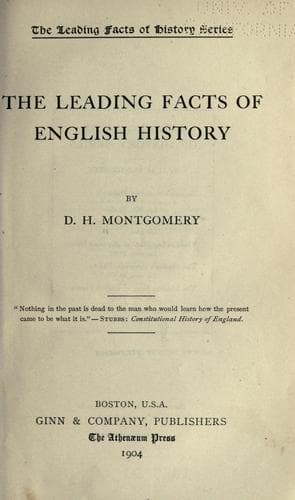
The Leading Facts of English HistoryMontgomery, D. H. (David Henry)
History
The Leading Facts of English History
Montgomery, D. H. (David Henry)
Great Britain -- History
This trade had long been coveted by the English, and had been carried
on to some extent by them ever since Sir John Hawkins entered upon it
in Queen Elizabeth's reign. Sir John grew very rich through his
traffic in human flesh, and he set up a coat of arms emblazoned with a
slave in fetters, so that all might see how he had won wealth and
distinction.
513. Union of England and Scotland, 1707.
Since the accession of James I (1603), England and Scotland had been
ruled by one sovereign, but each country retained its own Parliament
and its own forms of worship. In 1707 the two countries were finally
united under the name of Great Britain.
The Established (Presbyterian) Church of Scotland and the Scottish
laws were to be preserved. The independent Parliament of Scotland was
given up, and the Scotch were henceforth represented in the English
Parliament by sixteen peers chosen by members of the Scottish peerage
at the summoning of every Parliament; and by forty-five (now seventy-
two) members returned by Scotland to the House of Commons.
With the consummation of the union between the two countries Great
Britain adopted a new flag, the Union Jack, which was formed by the
junction of the red cross of St. George of England and the white cross
of St. Andrew of Scotland.[1]
[1] After Ireland was united to Great Britain (1800) the red cross of
St. Patrick was added to the flag (1801). The first Union Jack was
the work of James I, whose usual signature was Jacques (hence "Jack"),
French for James.
514. Literature of the Period; the First Daily Paper.
The reign of Anne has been characterized as one of corruption in high
places and of brutality in low, but in literature it takes rank next
to that of Elizabeth (S393). There was indeed no great central
luminary like Shakespeare, but a constellation of lesser ones,--such
as Addison, Defoe, and Pope. They shone with a splendor of their
own. The lurid brilliancy of the half-mad satirist Dean Swift was
beginning to command attention; on the other hand, the calm, clear
light of the philosopher John Locke was near its setting.
Aside from these great names in letters, it was an age generally of
contented dullness, well represented in the good-natured mediocrity of
Queen Anne herself. During her reign the first daily newspaper
(SS422, 443) appeared in England,--the Daily Courant (1703); it was a
dingy, badly printed little sheet, not much bigger than a man's hand.
The publisher said he made it so small "to save the Publick at least
one half the Impertinences of Ordinary News-Papers."
Perhaps it was well this journal set up no greater pretensions, for it
had to compete with swarms of abusive political pamphlets, such as
Swift wrote for the Tories and Defoe for the Whigs (S479). It had
also to compete with the gossip and scandal of the coffeehouses and
the clubs; for this reason the proprietor found it no easy matter
either to fill it or to sell it.
Public-domain text, read in full here on John Shaqi.
Reviews
Reviews
No reviews yet
Be the first to share your thoughts on this work.
Elsewhere in the archive
Join the Discussion
Join the discussion
Sign in to leave a comment or review.
Sign InorCreate an account