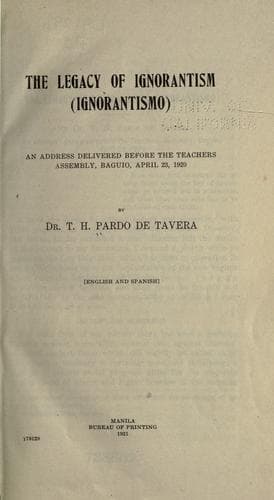
The Legacy of IgnorantismPardo de Tavera, T. H. (Trinidad Hermenegildo)
Religion
The Legacy of Ignorantism
Pardo de Tavera, T. H. (Trinidad Hermenegildo)
Church and education -- Philippines; Education -- Philippines
After having asked myself these questions and after having considered
the bases for the public clamor and for the excited opinion before the
sight of growing vice and immorality, I can say that this tendency
of public opinion is satisfying--a sign of betterment, of progress
of general morals. In other words, it is not immorality which is
growing. Rather, it is the moral consciousness which is gaining
ground in individual consciences, thus forming a public opinion which
formerly did not exist, completely awake to existing social evils and
which are combatted. Not that social morals has been decadent. On the
contrary, a moral consciousness has been rapidly formed in our society,
a consciousness which formerly was found only among an inconsiderable
minority, and which resulted in the new movement against vice and
immorality.
Public Opinion in Favor of Hygiene
To better understand this phenomenon and to explain it as it
really is and not as it apparently exists, it is worth while
to compare it with the appearance of a new sentiment which was
formed since the implantation of the American regime: the hygienic
consciousness. Formerly, hardly anybody spoke of the unsanitary
conditions of Manila, and only a few in our society had a true
idea of its deplorable state. Now that our individual education
has enabled us to understand what hygiene is and its importance has
been demonstrated, we have not only improved our sanitary condition
but a collective sentiment equal to the sum total of the individual
sentiments has been formed, and a public opinion in favor of hygiene
has been established. Since this opinion grows more rapidly than
sanitation itself in Manila, we see that every once in a while the
Bureau of Health is censured to the point of attributing to its
fault the increase of anti-hygienic conditions, when in reality what
increases is the clamor for hygiene by virtue of the increase of the
individuals who understand hygiene and demand strict application of
its laws and principles.
Now public opinion denounces hygienic shortcomings which are
incomparably less harmful than formerly, but which we view not in a
relative but absolute manner. An unsanitary condition is denounced
absolutely as an intolerable evil; relatively speaking our censure
would be less severe if we bore in mind that a similar ill is not
close at hand; we suffered in silence when we were ignorant not of its
existence but of its effects upon health, so then for us it existed
in a latent state and we did not see, feel, or notice it because of
lack of preparation. It is identical to what happens when at the
foot of a post charged with electric current is placed the sign:
"Danger to life." Such a sign is practically useless and is no means
of safety to the individual who does not know how to read. The one
who can read knows the danger; he who does not read does not avail
himself of the hygienic value of the danger signal.
Anti-Cockpit Campaign
Public-domain text, read in full here on John Shaqi.
Reviews
Reviews
No reviews yet
Be the first to share your thoughts on this work.
Join the Discussion
Join the discussion
Sign in to leave a comment or review.
Sign InorCreate an account