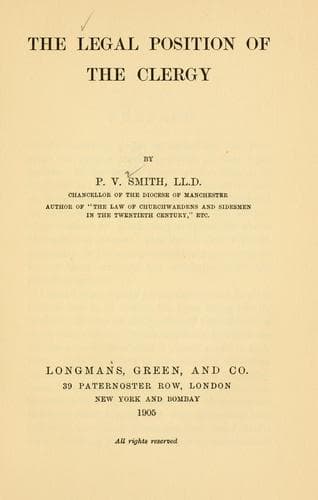
The Legal Position of the ClergySmith, Philip Vernon
Religion
The Legal Position of the Clergy
Smith, Philip Vernon
Canon law; Clergy -- Legal status, laws, etc. -- Great Britain; Ecclesiastical law -- Great Britain
Transcriber's Notes:
In this version, the oe ligature has been replaced by the two
letters, e.g. dioececis.
Text enclosed by underscores is in italics (_italics_).
Text enclosed by equal signs is in bold face (=bold=).
The original text contained Greek letters which have been
transliterated in this version and enclosed in asterisks,
e.g. *paroikia*.
Minor punctuation errors in the original text have been corrected
in this version.
Handbooks for the Clergy
EDITED BY
ARTHUR W. ROBINSON, B.D.
VICAR OF ALLHALLOWS BARKING
BY THE TOWER
THE LEGAL POSITION OF
THE CLERGY
THE LEGAL POSITION OF
THE CLERGY
BY
P. V. SMITH, LL.D.
CHANCELLOR OF THE DIOCESE OF MANCHESTER
AUTHOR OF "THE LAW OF CHURCHWARDENS AND SIDESMEN
IN THE TWENTIETH CENTURY," ETC.
LONGMANS, GREEN, AND CO.
39 PATERNOSTER ROW, LONDON
NEW YORK AND BOMBAY
1905
_All rights reserved_
PREFACE
In the following pages an endeavour has been made to give a succinct
sketch of the legal position of the parish clergy of the Church of
England in respect both of spiritualities and of temporalities. The
book, being intended for their use, does not touch upon the subject of
ordination by which they acquired the status of deacons or priests. Nor
does it deal with the episcopate or the non-parochial clergy, except so
far as these subjects are connected with the parochial system.
Like all other human arrangements, our English Church law is, of course,
far from being ideally perfect. It may be safely affirmed that there has
never been either a Church or a State in which the law has actually been
what it ideally ought to have been. It is important to recognise the
difference between the two positions; for there has sometimes been a
disposition on the part of individuals to confuse them, and to treat
what they consider to be the ideal law, as if it were the actual law,
and as if, as such, it demanded their loyal obedience. Such an attitude,
whether in ecclesiastical or civil matters, is anarchical in its
tendency; for it sets up private judgment instead of the constituted
authority as the criterion of what ought or ought not to be done. It can
only be justified where the actual law is absolutely inconsistent with
the fundamental principles of morality or of Christian truth. The object
of the present treatise is to state succinctly what the law is,--not
what it ought to be; and no opinion is expressed or suggestion offered
as to points in which amendment would be proper or expedient.
Public-domain text, read in full here on John Shaqi.
Reviews
Reviews
No reviews yet
Be the first to share your thoughts on this work.
Join the Discussion
Join the discussion
Sign in to leave a comment or review.
Sign InorCreate an account