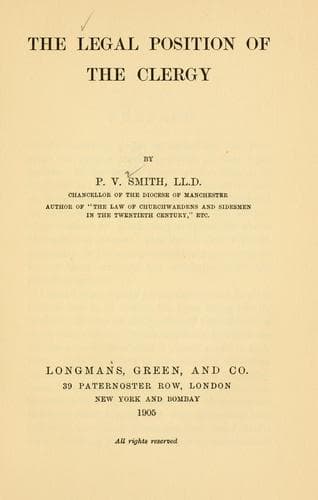
The Legal Position of the ClergySmith, Philip Vernon
Religion
The Legal Position of the Clergy
Smith, Philip Vernon
Canon law; Clergy -- Legal status, laws, etc. -- Great Britain; Ecclesiastical law -- Great Britain
25. Income or property tax is payable by an incumbent under schedule (A)
in respect of his house of residence, glebe lands, and tithe
rentcharge.[388] In respect of any landed property (other than a house
of residence) actually occupied by him, income tax is also payable on
one-third of its annual value, except that if he occupies it for the
sole purpose of husbandry and can show that his profits fell short of
that one-third, the tax is payable on the actual amount of the
profits.[389] The tax is also payable by him in respect of all other
stipend, fees, perquisites and profits accruing to him by reason of his
incumbency. But in estimating these a clergyman or other minister of
religion may deduct money paid and expenses incurred wholly,
exclusively, and necessarily in the performance of his ministerial
duties. In two Scotch cases these deductions were held to include the
expense of visiting members of his congregation, attending church
meetings enjoined on him as part of his duty, outlay on stationery, and
communion expenses; but no deduction was allowed in respect of part of
the manse used as an office for his clerical business, or for the cost
of books or for a voluntary contribution made by him towards the stipend
of an assistant minister.[390] There is sometimes a difficulty in
determining whether sums of money which are granted or given to a
clergyman, but are not part of his legal or recognised stipend, are
taxable perquisites or profits accruing to him by reason of his office
or not. The true test, namely, whether the gift is made to him in
respect of his office or is personal to himself, is not easy to apply in
particular instances. In another Scotch case it was held that a
voluntary contribution made by parishioners to their minister, and
received by him in respect of the discharge of the duties of his office,
was taxable.[391] A grant to a curate by the Curates' Augmentation Fund
in recognition of upwards of fifteen years' faithful service is not
taxable, not being made in respect of performing present duties. But a
grant to an incumbent from the Queen Victoria Clergy Fund, being made in
respect of the poverty of his benefice, was decided by the Court of
Appeal to be taxable, although the Divisional Court below had held the
contrary.[392]
Footnotes
[317] 51 & 52 Vict. c. 42; 54 & 55 Vict. c. 73.
Public-domain text, read in full here on John Shaqi.
Reviews
Reviews
No reviews yet
Be the first to share your thoughts on this work.
Elsewhere in the archive
Join the Discussion
Join the discussion
Sign in to leave a comment or review.
Sign InorCreate an account