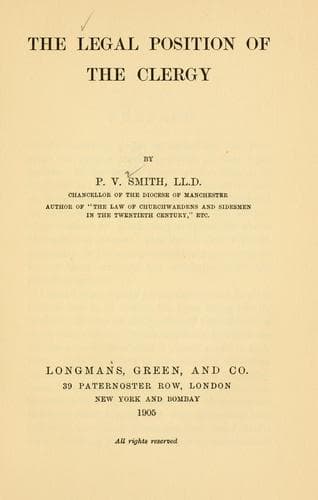
The Legal Position of the ClergySmith, Philip Vernon
Religion
The Legal Position of the Clergy
Smith, Philip Vernon
Canon law; Clergy -- Legal status, laws, etc. -- Great Britain; Ecclesiastical law -- Great Britain
23. In some cases the incumbent's stipend depends wholly or in part upon
pew rents. They can only legally be taken where authorised by a special
or general Act of Parliament. In some churches they have been sanctioned
by a special Act, which prescribes their application, and the proportion
(if any) which shall go towards the incumbent's stipend. They are also
sanctioned in certain cases by the Church Building Acts and New Parishes
Acts. Where pew rents are fixed under these Acts, the incumbent is
entitled to such portion of them as may be settled in the manner therein
prescribed;[382] and he can recover that portion from the churchwardens
by an action at law.[383] An incumbent, who has a vote for a
parliamentary borough as a resident therein, and who receives for his
own use part of the pew rents of the church, which is also situate in
the borough, but which is his freehold, has a parliamentary vote for the
county as a freeholder, since he does not occupy the church within the
meaning of 2 & 3 Will. 4, c. 45, s. 24.[384]
24. The incumbents of certain ancient benefices above the yearly value
of £50 are liable to the payment to Queen Anne's Bounty of first fruits
in the first year of their incumbency and tenths in succeeding years.
The first fruits are the amount of one year's value of the benefice as
recorded in the _valor beneficiorum_ or King's Books compiled in the
sixteenth century, and the tenths are one-tenth of the same amount. They
were originally paid to the Pope, and were annexed by Henry VIII. to the
Crown, until Queen Anne bestowed them on the Bounty which bears her
name, to form a fund for the augmentation of poor livings. Where they
are payable, first fruits are due three months after admission to the
benefice, and tenths annually at Christmas. An incumbent is only
chargeable with the whole of the first fruits if he remains incumbent at
the end of two years from the occurrence of the vacancy which he was
appointed to fill. He is liable to none, or to one-fourth, one-half or
three-fourths, if he dies or is removed within the first, second, third,
or fourth half-year after that event.[385] Two Acts passed in 1706 and
1707[386] discharged from the payment of first fruits and tenths all
benefices which at the time were under the annual value of £50, except
that those of which the tenths had been previously granted away by the
Crown to other parties were still to continue liable to tenths only.
Other exemptions have been granted in favour of particular benefices at
different times; and in 1837, out of 10,498 benefices with and without
cure of souls, only 4898 remained liable to tenths, 4500 of that number
being also liable to first fruits.[387]
Public-domain text, read in full here on John Shaqi.
Reviews
Reviews
No reviews yet
Be the first to share your thoughts on this work.
Elsewhere in the archive
Join the Discussion
Join the discussion
Sign in to leave a comment or review.
Sign InorCreate an account