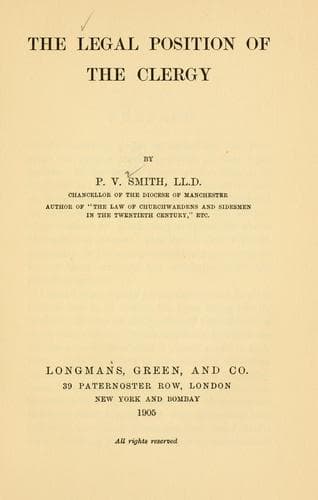
The Legal Position of the ClergySmith, Philip Vernon
Religion
The Legal Position of the Clergy
Smith, Philip Vernon
Canon law; Clergy -- Legal status, laws, etc. -- Great Britain; Ecclesiastical law -- Great Britain
9. All rectories, vicarages, and perpetual curacies, whether ancient or
established under the Church Building and New Parishes Acts, or under
any special Act of Parliament, fall within the term _benefice_, and are
of freehold tenure. The term is also applied to non-parochial
ecclesiastical offices of a like tenure, such as a deanery, canonry, and
archdeaconry. But in the present treatise, which deals only with the
parochial clergy, it will be used exclusively of the above-named
parochial benefices (which are in popular language called _livings_);
and the clergy who hold these benefices will be called beneficed clergy
or incumbents. The other parochial clergy will be referred to as
unbeneficed clergy or curates. The legal position of the unbeneficed
clergy as regards status and property is so different from that of
incumbents that it will be convenient to treat of them separately. But
the spiritual duties of the two classes, and the discipline to which
they are amenable, are similar and can be discussed together. They are
alike subject to the same superior ecclesiastical officials and to the
same judicial proceedings; and their civil privileges and disabilities
in respect of their clerical office are identical. By virtue of their
position as parochial clergy they are brought into certain relations
with the bishop of the diocese, the archdeacon of the archdeaconry, and
the rural dean of the deanery in which their parish is situate.
10. The bishop is not only the ruler and administrator, but also the
chief pastor of the whole of his diocese. As such, he, assisted by his
chaplain, has the right whenever he pleases, without the consent of the
incumbent, to conduct service or preach in the church of any parish in
such lawful manner as he thinks proper. This right extends to
consecrating a church within the parish[16] and, of course, to holding
ordinations and confirmations. Moreover, he can require from the clergy
all reasonable information respecting their parish and parishioners.
They owe to him canonical obedience,[17] and deference in matters which
do not fall within the limits of obedience. With the exception that his
withdrawal of a licence from a curate is subject to an appeal to the
archbishop, he possesses absolute control over the unbeneficed clergy in
his diocese, having the right to inhibit them from officiating within
it. But he has no such power over the beneficed clergy in respect of
their services in their own church and other matters involved in the
cure of souls attaching to their benefice. In respect of these matters,
their office being a freehold for life, they are independent of him
except in such particulars and to such extent as the law has expressly
prescribed, and they can only be constrained by him against their will
through the instrumentality of legal proceedings. But, equally with the
unbeneficed clergy of the diocese, it is their duty to attend the
bishop's triennial visitations; and their absence without sufficient
Public-domain text, read in full here on John Shaqi.
Reviews
Reviews
No reviews yet
Be the first to share your thoughts on this work.
Join the Discussion
Join the discussion
Sign in to leave a comment or review.
Sign InorCreate an account