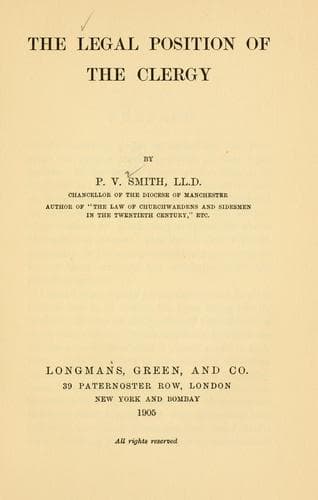
The Legal Position of the ClergySmith, Philip Vernon
Religion
The Legal Position of the Clergy
Smith, Philip Vernon
Canon law; Clergy -- Legal status, laws, etc. -- Great Britain; Ecclesiastical law -- Great Britain
property of the Church, are so interlaced, that on many points friction
cannot be avoided without that harmonious co-operation which should
always exist between them, or, if this is unfortunately impossible, at
any rate without mutual forbearance and concession.
5. The 90th Canon directs that the minister and parishioners in every
parish, if they can agree, shall yearly in Easter week choose two or
three or more discreet persons as sidemen (or, as they are now called,
sidesmen) to assist the churchwardens in performing the duties of their
office. If no agreement is come to, they are to be appointed by the
bishop. This Canon only applies to ancient parishes, and therefore
sidesmen appointed, as is frequently the case, in new ecclesiastical
parishes have, strictly speaking, no legal status. They are, however,
frequently treated as if they possessed it, and in these, as well as in
ancient parishes, assist the churchwardens in seating the people and
taking the collections in church. No practical harm is likely to result
from this unless they undertook such a duty as, for instance, the
forcible ejection of a person misbehaving in church, in which case their
right to do so might be called in question.
6. In addition to the churchwardens a body of Church trustees may now be
appointed in any parish to accept contributions and hold funds for
certain defined ecclesiastical purposes.[150] They are to consist of the
incumbent and two householders or owners or occupiers of land in the
parish, chosen in the first instance and on the happening of a vacancy,
one by the patron and the other by the bishop, the incumbent being
chairman. They are a body corporate under the name of the Church
Trustees of the parish in which they are appointed, with perpetual
succession and a common seal, and power to sue and be sued in their
corporate name. As circumstances from time to time require, they may
pay over funds in their hands to the churchwardens to be applied to the
defined ecclesiastical purposes of the parish generally or to one or
more of them specifically, due regard being had to any particular
directions of the donors. Funds not so paid over may be invested in
government or real securities and accumulated, with a view to the
capital or income being applied at a subsequent time. At least once a
year the trustees must lay before the vestry all accounts and
particulars of their receipts and expenditure during the preceding year,
and of the balance of funds in their hands.[151]
Public-domain text, read in full here on John Shaqi.
Reviews
Reviews
No reviews yet
Be the first to share your thoughts on this work.
Elsewhere in the archive
Join the Discussion
Join the discussion
Sign in to leave a comment or review.
Sign InorCreate an account