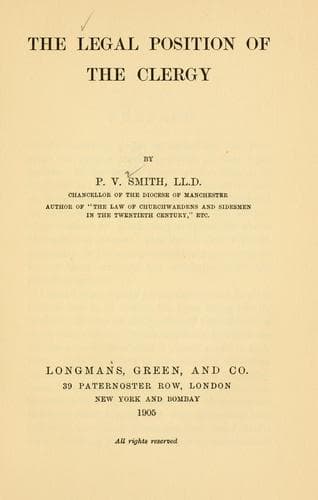
The Legal Position of the ClergySmith, Philip Vernon
Religion
The Legal Position of the Clergy
Smith, Philip Vernon
Canon law; Clergy -- Legal status, laws, etc. -- Great Britain; Ecclesiastical law -- Great Britain
discretion, to order two full services (each, if he so directs, to
include a sermon or lecture) on every Sunday throughout the year or any
part of the year in the church or chapel of any benefice, whatever its
annual value or population, and also in certain cases where a benefice
is composed of more than one parish or chapelry, in the church or chapel
of each of them.[170] And where he considers that the population
requires it, he may direct the celebration on Sundays and the great
festivals of a third service, being either the Morning or Evening
Service with a third sermon, and for the performance of this third
service may insist on a curate being nominated, whose salary is to be
provided by the pews being specially let for the service or by
subscription.[171] It is rarely necessary in the present day to put in
force these powers, since in most parishes the number of services
considerably exceeds the legal _minimum_.
3. Under the rubrics following the Nicene Creed and at the beginning of
the Marriage Service, as modified by the Parish Notices Act, 1837,[172]
the minister is alone authorised to give out notices during Divine
service; and he may not publish either during or after Divine service
notices of proceedings in ecclesiastical courts, or of vestry meetings,
or of any other matter except banns of matrimony, announcements of the
Communion, and of holy days and fasting days during the ensuing week,
and of anything else prescribed by the Prayer Book or enjoined by the
King or the ordinary. Other notices must be put up at or near the church
door. Banns are to be published at the time of Morning Service (or of
Evening Service if there is no Morning Service) immediately after the
Second Lesson. Other lawful notices are to be given at the close of the
Nicene Creed.
4. The only rubrical provision for the collection of money during Divine
service is at the time when the offertory sentences are read, whether a
Communion follows or not. The money is then to be received by the
deacons, churchwardens, or other fit person,[173] and is to be disposed
of to such pious and charitable uses as the minister and churchwardens
think fit; wherein if they disagree, it is to be disposed of as the
ordinary shall appoint. Money collected at other times during Divine
service ought to be brought up to the minister to be placed on the Holy
Table, like the offertory money; but, unlike this, it is under the sole
control and disposal of the incumbent; unless it is collected for church
expenses or repairs for which the churchwardens are responsible, in
which case it should be handed over to them.[174] And if the purpose for
which the collection is made is announced beforehand, there is, of
course, a legal as well as moral obligation to apply the money collected
to that purpose. Offertory alms collected in a chapel are at the
disposal of the incumbent and wardens of the parish church.[175]
Public-domain text, read in full here on John Shaqi.
Reviews
Reviews
No reviews yet
Be the first to share your thoughts on this work.
Elsewhere in the archive
Join the Discussion
Join the discussion
Sign in to leave a comment or review.
Sign InorCreate an account