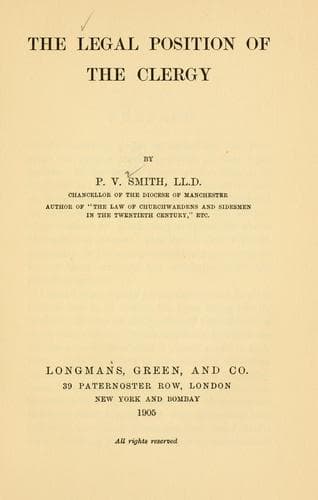
The Legal Position of the ClergySmith, Philip Vernon
Religion
The Legal Position of the Clergy
Smith, Philip Vernon
Canon law; Clergy -- Legal status, laws, etc. -- Great Britain; Ecclesiastical law -- Great Britain
5. Questions arose during the last century as to (_A_) the legality of
certain ornaments of the Church, (_B_) the dress of the clergy, and
(_C_) ceremonies in connection with Divine service, and especially with
the Holy Communion; having regard, among other considerations, to the
Ornaments Rubric in the Prayer Book. According to the legal decisions on
these questions:[176] (_A_) The Holy Table must be of wood and,
according to Canon 82, should be covered during Divine service with a
carpet of silk or other decent stuff, and with a fair linen cloth at the
time of the ministration.[177] A crucifix, except as a mere
architectural decoration or as part of an historical representation of
the Crucifixion, is illegal; but a cross is legal, provided it be not
upon or in actual or apparent contact or connection with the Holy
Table.[178] Candlesticks and vases of flowers are legal even in such
contact or connection,[179] and so are pictures or sculptures of an
historical or allegorical character, whether in a reredos or elsewhere
in the church, except those known as the Stations of the Cross, which
have been held liable to superstitious abuse.[180] The legality of
isolated figures, whether painted or sculptured, depends on whether from
their character and position there is no likelihood of their being
superstitiously reverenced.[181] A credence table is legal and
proper.[182] A second Holy Table is only legal if placed in a part of
the church closed in, by lattice work or otherwise, as a separate place
of worship for services attended by few worshippers.[183] Chancel gates
are permitted, if required for the protection of the chancel when the
church is accessible for private prayer; but they must be always kept
open during Divine service.[184] The erection of a baldacchino or canopy
over the Holy Table is not permissible.[185] But the introduction of
legal ornaments and additions into a church will not ordinarily be
sanctioned without the approval of the parishioners, expressed by a
resolution of the vestry.[186] (_B_) The legal attire of the ministering
clergy at the Holy Communion, as well as in other ministrations, has
been decided to be that laid down by the Advertisements of 1566, which
are followed in Canons 24, 25, and 58, and prescribe the wearing of a
surplice with the proper hood of the university degree (if any); except
that in cathedral and collegiate churches the celebrant and gospeller
and epistler shall wear copes. The rubric of the First Prayer Book of
Edward VI., had directed that the celebrant should wear a white albe
plain with a vestment (_i.e._ a chasuble) or cope, and any assistant
priests or deacons should wear albes with tunicles.[187] Stoles, as
distinguished from the scarves of chaplains, have no legal
authority.[188] A biretta (the foreign form of a college cap) must not
be worn during the Communion Service.[189] In preaching (except,
possibly, during the Communion Office) the surplice or the black gown
Public-domain text, read in full here on John Shaqi.
Reviews
Reviews
No reviews yet
Be the first to share your thoughts on this work.
Elsewhere in the archive
Join the Discussion
Join the discussion
Sign in to leave a comment or review.
Sign InorCreate an account