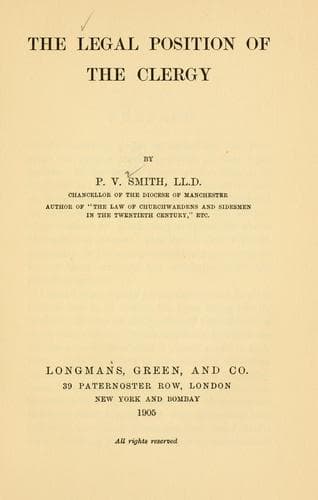
The Legal Position of the ClergySmith, Philip Vernon
Religion
The Legal Position of the Clergy
Smith, Philip Vernon
Canon law; Clergy -- Legal status, laws, etc. -- Great Britain; Ecclesiastical law -- Great Britain
are equally legal.[190] (_C_) The ceremonial use of incense and
processions with lighted candles are illegal,[191] but a celebration of
Holy Communion with two lighted candles on or above the table is
permissible.[192] The administration of the mixed chalice is legal, but
the wine and water must not be ceremonially mixed during the
service.[192] Wafers, not consisting of bread "such as is usual to be
eaten," have been held illegal.[193] The singing of the Agnus Dei or of
any other hymns during the administration of the elements is
permissible.[194] A minister may stand either on the north or the west
side of the table during the service; but not so as to hide the manual
acts from the people.[192] He must not kneel or bow before the elements
during the Prayer of Consecration, or elevate them above his head during
administration; nor may he use the sign of the cross during the
absolution or benediction.[195] Ablutions of the paten and chalice
after the benediction, being no part of the service, are not
illegal.[196] Reservation of any parts of the consecrated elements at
the close of the Communion Service is illegal.[197]
6. No minister is to refuse or delay to christen according to the form
of the Book of Common Prayer any child brought to him to the church for
that purpose on a Sunday or holy day, after notice given to him
overnight or in the morning before the beginning of Morning Prayer. The
ceremony should take place immediately after the second lesson at either
Morning or Evening Prayer. The congregation can then testify the
receiving of the newly baptized into the number of Christ's Church, and
all present are reminded of their own profession made to God in their
baptism. But if necessity requires, children may be baptized on any
other day.[198] The law is the same as regards children of Church people
and of Dissenters, and as regards legitimate and illegitimate children.
If a minister is duly informed of the weakness and danger of death of an
unbaptized infant in the parish, and is desired to go and baptize him,
he must not refuse or so delay that the infant dies through his fault
unbaptized.[199] But in every other case a male child must have two
godfathers and one godmother, and a female child one godfather and two
godmothers; and a minister will, of course, not admit as a sponsor a
person notoriously leading an immoral life or otherwise manifestly unfit
for the office. Godparents must have received the Holy Communion, and a
father cannot be godfather for his own child.[200] In 1865 the
Canterbury Convocation, with the Royal licence, framed a new canon
repealing this prohibition; but the canon was never ratified by the
Crown, nor was any similar canon passed by the York Convocation. The
Form for the ministration of Private Baptism in houses contains a
service for the public reception in church, as one of the flock of true
Christian people, of a child who, in case of emergency, has been
Public-domain text, read in full here on John Shaqi.
Reviews
Reviews
No reviews yet
Be the first to share your thoughts on this work.
Elsewhere in the archive
Join the Discussion
Join the discussion
Sign in to leave a comment or review.
Sign InorCreate an account