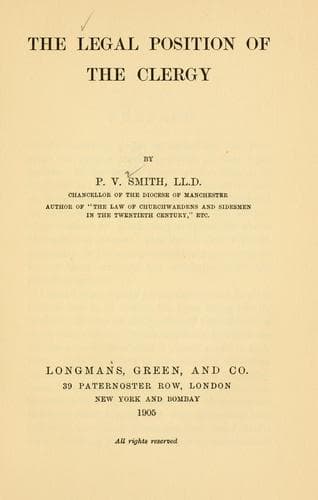
The Legal Position of the ClergySmith, Philip Vernon
Religion
The Legal Position of the Clergy
Smith, Philip Vernon
Canon law; Clergy -- Legal status, laws, etc. -- Great Britain; Ecclesiastical law -- Great Britain
baptized at home, and also a formula of conditional baptism to be
substituted for the words of actual baptism in cases where there is a
doubt whether the essential parts of the Sacrament were observed in the
private performance of the ceremony. The rubrics direct immersion in the
case of the public baptism of infants, if the godparents certify that
the child can endure it, and affusion, if they certify that the child is
weak. Naturally, affusion alone is directed in the case of private
baptism. In the case of the baptism of adults, immersion or affusion are
directed as alternatives, the discretion being left with the minister
and not with the godparents. The rubric directs that, before adult
persons are to receive baptism, not less than one week's previous
notice shall be given to the bishop, or a person appointed by him, by
the parents or some other discreet persons, in order that due care may
be taken for their examination as to their knowledge of the principles
of the Christian religion, and that they may be exhorted to prepare with
prayers and fasting for the reception of that holy Sacrament. The
baptismal services throughout contemplate the performance of the
ceremony by a priest; but in the Form of Making of Deacons a deacon is
expressly authorised to baptize infants in the absence of the priest.
Lay baptism is valid in case of emergency; but, of course, a layman is
not at liberty to use the baptismal service.
7. The Holy Communion is to be administered in every parish church and
chapel so often and at such times as that every parishioner may
communicate at least twice in the year (whereof the feast of Easter
shall be one).[201] Warning is to be given to the parishioners "publicly
in church at Morning Prayer" on the Sunday before every time of
administering the Holy Communion,[202] and the present rubric requires
that so many as intend to be partakers of the Sacrament shall signify
their names to the curate, meaning the incumbent, at least some time the
day before. In the First Prayer Book of Edward VI. this rubric ran: "So
many as intend to be partakers of the Holy Communion shall signify
their names to the curate overnight or else in the morning afore the
beginning of Matins or immediately after."[203] The incumbent must not
deny the Sacrament, without lawful cause, to any person that devoutly
and humbly desires to receive it.[204] But he is directed both by the
Canons and by the rubric to repel from Communion, until repentance, open
and notorious evil livers, and those who have wronged their neighbours
by word or deed so as to offend the congregation, and those between whom
he perceives malice and hatred to reign. The Canons add to the list
common and notorious depravers of the Book of Common Prayer, or the
Ordering of Bishops and Priests, or the Thirty-nine Articles, or
depravers of the sovereign authority of the King in causes
ecclesiastical, and those who refuse to kneel when receiving the
Public-domain text, read in full here on John Shaqi.
Reviews
Reviews
No reviews yet
Be the first to share your thoughts on this work.
Elsewhere in the archive
Join the Discussion
Join the discussion
Sign in to leave a comment or review.
Sign InorCreate an account