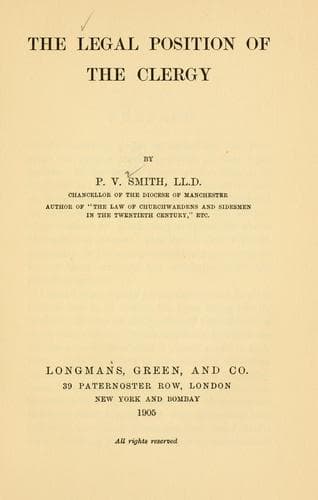
The Legal Position of the ClergySmith, Philip Vernon
Religion
The Legal Position of the Clergy
Smith, Philip Vernon
Canon law; Clergy -- Legal status, laws, etc. -- Great Britain; Ecclesiastical law -- Great Britain
10. The Churching of Women is regulated by the rubrics at the
commencement and close of the service for the occasion in the Prayer
Book. It is contemplated as the first service in which a woman takes
part after recovery from childbirth; but no specific time is prescribed
for it beyond the recommendation that she should receive the Holy
Communion if there be a Communion. In former times a woman was not to be
churched after an illegitimate birth unless she had previously done
penance or acknowledged her fault before the congregation at the time of
her churching. Since penance has fallen into disuse, a clergyman must
exercise his own discretion in such cases; but he will, of course,
neither church nor admit to Communion a woman who impenitently continues
a sinful life. The rubric directs that "accustomed offerings" shall be
offered at a churching, but their amount is not regulated by any general
or well-established rule.[212]
Footnotes
[162] Ch. ii. § 6 (i.); ch. iii. § 1; (1865) 28 & 29 Vict. c. 122, ss.
1, 4-8.
[163] (1559) 1 Eliz. c. 2; (1662) 14 Cha. 2, c. 4; (1872) 35 & 36 Vict.
c. 35; Westerton _v._ Liddell (1857) Moore's Special Report, 187; Martin
_v._ Mackonockie (1868) L. R. 2 P. C. 365, at p. 383; 38 L. J. Eccl. 1,
at p. 11.
[164] Newbery _v._ Goodwin (1811) 1 Phill. 282.
[165] Gibs. Cod. 280; see note to ch. ii. § 6 (i.) above.
[166] As to the normal order independently of the Act, see the Rubrics
and note to § 7 below.
[167] Cripps, 576.
[168] _Re_ Hartshill Endowment (1861) 30 Beav. 130.
[169] This applies only to a church served by a distinct minister, and
not where there are two churches in one parish. But even in such a case
the incumbent has no right wholly to close one church and hold all the
Sunday services in the other; Rugg _v._ Bp. of Winchester (1868) L. R. 2
P. C. 223; 38 L. J. Eccl. 23.
[170] (1838) 1 & 2 Vict. c. 106, s. 80.
[171] (1818) 58 Geo. 3, c. 45, ss. 65, 66.
[172] 7 Will, 4 & 1 Vict. c. 45.
[173] The appointment of such person rests with the incumbent or
principal officiating minister; a clergyman in priest's orders is not a
"fit" person to collect the offertory money. Cope _v._ Barber (1872) L.
R. 7 C. P. 393.
[174] Sm. Churchw. 80; Reg. _v._ O'Neill (1867) 31 J. P. 742; Howell
_v._ Holdroyd (1897) P. 198. An incumbent often takes sole charge not
only of money collected in church but of money collected by appeals
within and outside the parish. He should in all such cases lodge it at a
bank on a separate account, and notify in his appeal that this will be
done. He cannot otherwise reasonably expect to be entrusted with money
by strangers; and if the money is mixed with his own, it may be
difficult or impossible to disentangle it in the event of his sudden
illness and death.
[175] Moysey _v._ Hillcoat (1828) 2 Hag. Eccl. 30, at p. 56.
Public-domain text, read in full here on John Shaqi.
Reviews
Reviews
No reviews yet
Be the first to share your thoughts on this work.
Elsewhere in the archive
Join the Discussion
Join the discussion
Sign in to leave a comment or review.
Sign InorCreate an account