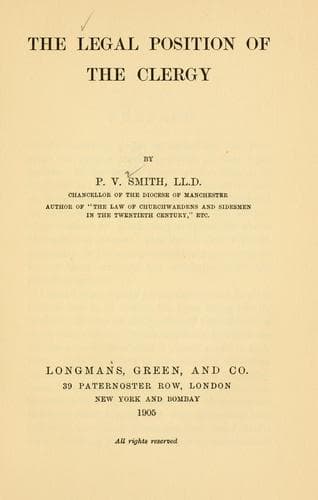
The Legal Position of the ClergySmith, Philip Vernon
Religion
The Legal Position of the Clergy
Smith, Philip Vernon
Canon law; Clergy -- Legal status, laws, etc. -- Great Britain; Ecclesiastical law -- Great Britain
As the rubrics
stand, such persons, unless and until actually confirmed, have no right
to require a clergyman to admit them to Communion, and he commits no
legal offence by refusing to do so. On the other hand, a considerable
number of such persons do, as a matter of fact, communicate in our
Church without having been confirmed or being desirous to be confirmed;
and a clergyman who admits them, in the absence of any direction of the
bishop to the contrary,[209] may be acting in a wise and Christian
manner.
8. The rubrics of the Communion Office prescribe that a sermon or one of
the authorised homilies shall follow the Nicene Creed whenever that
portion of the office is used, whether a Communion actually takes place
afterwards or not. And the 45th Canon enjoins the preaching of one
sermon every Sunday of the year. The power of the bishop to require a
second and even, in certain cases, a third sermon has already been
noticed.[210] But, inasmuch as the Prayer Book contains no direction
that sermons shall follow Matins or Evensong, such sermons may be
regarded as in the nature of separate or additional services. The 55th
Canon prescribes that all sermons, lectures, and homilies shall be
preceded by what is called the Bidding Prayer and the Lord's Prayer. But
this rule is not in practice observed in the case of sermons in the
middle of the Communion Service or immediately following some other
service. Under the Act of Uniformity Amendment Act of 1872, Morning and
Evening Prayer, the Litany, and Holy Communion may any of them be used
with or without the preaching of a sermon or lecture or the reading of a
homily; and a sermon or lecture may be preceded either by one of the
services appointed by the Prayer Book or by a service authorised by that
Act, or by a Collect taken from the Prayer Book, with or without the
Lord's Prayer.[211]
9. Regular catechising is enjoined both by the Canons and by the Prayer
Book. But the direction in the 59th Canon, that it shall take place for
half-an-hour or more before Evening Prayer, is superseded by the rubric
at the end of the Catechism, which requires the incumbent of every
parish diligently upon Sundays and holy days, after the second lesson
at Evening Prayer, openly in the church to instruct and examine so many
children of his parish sent to him as he shall think convenient, in some
part of the Catechism.
Public-domain text, read in full here on John Shaqi.
Reviews
Reviews
No reviews yet
Be the first to share your thoughts on this work.
Elsewhere in the archive
Join the Discussion
Join the discussion
Sign in to leave a comment or review.
Sign InorCreate an account