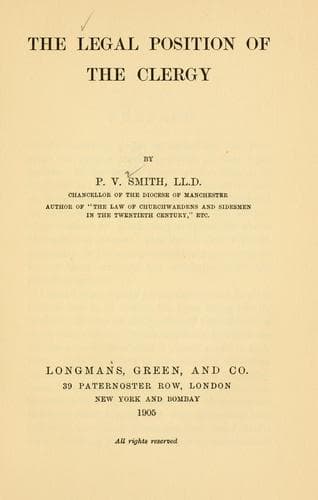
The Legal Position of the ClergySmith, Philip Vernon
Religion
The Legal Position of the Clergy
Smith, Philip Vernon
Canon law; Clergy -- Legal status, laws, etc. -- Great Britain; Ecclesiastical law -- Great Britain
2. The ancient parish churches were the original places for the
publication of banns and solemnisation of marriages;[215] but the
churches of new ecclesiastical parishes now stand upon the same footing
in that respect as those of ancient parishes; and where a portion of an
ancient parish has been formed into a new ecclesiastical parish,
residents in the new parish are not deemed for those purposes to be
within the old parish.[216] Moreover, if, besides the church, there is a
public chapel in a parish, and the bishop thinks it necessary so to do
for the convenience of the inhabitants, he may grant a licence, with
such qualifications as he may deem fit, for banns and marriages in the
chapel, in the case of residence within a district specified in the
licence; subject to an appeal on the part of either patron or incumbent
to the archbishop of the province, who may confirm, revoke, or vary the
licence. But the licence will not preclude residents in the district
from having their banns published and marriages solemnised in the parish
church, if they prefer this course.[217] In the case of parishes having
no parish church in which Divine service is usually performed every
Sunday, and in the case of extra-parochial places, the church or chapel
of an adjoining parish or chapel may be resorted to for banns and
marriages.[218] But the bishop may license for banns and marriages in
extra-parochial places and chapelries any church or chapel situate
within their limits.[219] Where the church of a parish is pulled down or
disused for Divine service owing to being rebuilt or repaired, the
publication of banns and solemnisation of marriages may take place in
any building within the parish licensed by the bishop for the
performance of Divine service during the rebuilding or repair of the
church, or if there is no such building, then in the church of an
adjoining parish; or, if there is a consecrated chapel within the
parish, the bishop may direct that they shall take place within that
chapel, and may, with the consent of the incumbent, give directions
respecting the fees. Licences for marriages in the church of the parish
are to be construed as licences for marriages in the building, church,
or chapel in which they may be temporarily solemnised.[220] Where a
church has been rebuilt, repaired, or enlarged, and the position of the
Holy Table altered, the validity of marriages and other ceremonies is
not affected by the fact, if such is the case, of there having been no
re-consecration.[221]
Public-domain text, read in full here on John Shaqi.
Reviews
Reviews
No reviews yet
Be the first to share your thoughts on this work.
Elsewhere in the archive
Join the Discussion
Join the discussion
Sign in to leave a comment or review.
Sign InorCreate an account