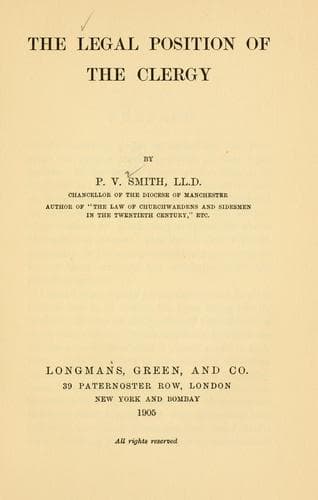
The Legal Position of the ClergySmith, Philip Vernon
Religion
The Legal Position of the Clergy
Smith, Philip Vernon
Canon law; Clergy -- Legal status, laws, etc. -- Great Britain; Ecclesiastical law -- Great Britain
3. Persons are legally competent to intermarry who (_a_) are of a legal
age to contract marriage, (_b_) are of sound mind, (_c_) have not at the
time a wife or husband living with whom they have contracted a marriage
which is recognised by English law and has not been declared void or
been dissolved by a divorce a _vinculo_ recognised by English law, and
(_d_) are not within the prohibited degrees of consanguinity or
affinity. A Christian and a non-Christian may be married in church, as
well as Christians of different denominations; and a clergyman cannot
make religion or absence of religion a ground for refusing to perform
the ceremony.[222]
4. The _minimum_ legal age for contracting marriage is fourteen for the
husband and twelve for the wife. In the case of minors the consent of
parents or guardians is necessary to their marriage after banns. In the
case of the marriage by licence of a minor who is not a widower or
widow, the consent to the marriage must be obtained from the father if
living, and if he is dead, from some one guardian of the minor (if any).
The mother, whether still a widow or remarried, is by law a guardian of
the minor unless she has been removed from the office by the High Court
of Justice. If she has been so removed and she remains a widow, and
there is no guardian in existence, her consent to the marriage is
necessary. Where no requisite consenting party is in existence, the
marriage may be solemnised without consent. If the father, mother, or
other guardian is of unsound mind, or abroad, or unreasonably withholds
consent, the Lord Chancellor or some other Chancery judge may on
petition make declaration that the marriage is proper, which will
supersede the necessity for the consent.[223] This consent of parents is
not required in the case of a minor who is illegitimate.[224] A
clergyman is not punishable who, without notice of the fact, solemnises
the marriage of a party under the lawful age, or the marriage of a minor
without the consent of parent or guardian; and the marriage of a minor
above the marriageable age without such consent, if it actually takes
place, is valid, and cannot be made void.[225] But the marriage of a
person under the lawful age can be declared void by him or her on
attaining that age. If, however, he or she then consents to the union,
no remarriage is necessary.[226]
5. The marriage of a person who is a lunatic or of unsound mind is void,
since such a person is not capable of consenting to the ceremony.[227]
On the same principle, if a person is forced to go through the ceremony
against his or her will, it is no marriage and void.[228]
6. Where a married person is absent and unheard of for seven years, a
presumption of death arises, and the other party marrying again after
the lapse of that time is not punishable for bigamy.[229] But the
remarriage will of course be void if it subsequently appears that the
absent party was actually alive at the time when it was solemnised.
Public-domain text, read in full here on John Shaqi.
Reviews
Reviews
No reviews yet
Be the first to share your thoughts on this work.
Elsewhere in the archive
Join the Discussion
Join the discussion
Sign in to leave a comment or review.
Sign InorCreate an account