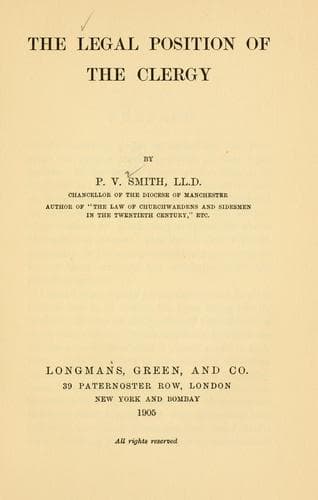
The Legal Position of the ClergySmith, Philip Vernon
Religion
The Legal Position of the Clergy
Smith, Philip Vernon
Canon law; Clergy -- Legal status, laws, etc. -- Great Britain; Ecclesiastical law -- Great Britain
8. Although marriages duly solemnised in England according to English
law between foreigners, or between a foreigner and a British subject,
are valid throughout the British Empire, these marriages will not
necessarily be valid in countries to which the foreigners belong, unless
the legal requirements of these countries are complied with. Under
arrangements made with France and Belgium, the French Consul and the
Belgian Minister respectively will, on application, ascertain in any
particular case that the legal requirements of their country have been
complied with, and will furnish a certificate to that effect. No similar
arrangement has as yet been made with any other foreign State. The
following instructions have therefore been issued in the diocese of
London, and may, with advantage, be observed elsewhere, namely:--(_a_)
Where both parties to an intended marriage are foreigners, or one of
them is a foreigner of any nationality except French or Belgian, or is a
foreigner without a permanent residence in England, the marriage should
in all cases be by licence, which will only be granted if the chancellor
of the diocese is satisfied that the law of the country, to which the
foreigners concerned belong, is complied with.[234] (_b_) Where a
foreigner of French or Belgian nationality, whose permanent residence is
in England, is a party to an intended marriage after banns with an
English subject, the incumbent of the parish should require before
solemnising it the production of a certificate from the French Consul or
Belgian Minister, as the case may be, that all the legal requirements
necessary to the recognition of the marriage as valid in France or
Belgium have been complied with.
9. Marriages of persons within the prohibited degrees of kindred and
affinity specified in the Table set forth by the authority of Archbishop
Parker in the year 1563 are unlawful and void.[235] The degrees include
illegitimate as well as legitimate relatives and connections; but an
illegitimate _liaison_ with a woman or a man does not make her or him a
wife or a husband within the meaning of the Table. Thus a man cannot
marry his wife's illegitimate daughter or her half-sister, whether
legitimate or illegitimate; but he can marry the daughter or sister of a
woman with whom he has had unlawful connection.[236]
Public-domain text, read in full here on John Shaqi.
Reviews
Reviews
No reviews yet
Be the first to share your thoughts on this work.
Elsewhere in the archive
Join the Discussion
Join the discussion
Sign in to leave a comment or review.
Sign InorCreate an account