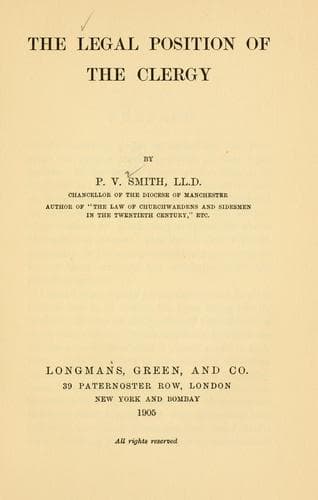
The Legal Position of the ClergySmith, Philip Vernon
Religion
The Legal Position of the Clergy
Smith, Philip Vernon
Canon law; Clergy -- Legal status, laws, etc. -- Great Britain; Ecclesiastical law -- Great Britain
10. Under the Marriage Act, 1823, which slightly differs in language
from Canon 62 and the rubrics in the Prayer Book, banns must be
published on three Sundays (without an alternative of holy-days), and
after the second lesson (instead of after the Nicene Creed) in morning
service or in evening service if there is no morning service,[237]
according to the form of words prescribed by the rubric. A slight
deviation from this form will not invalidate the publication. A
clergyman is not obliged to publish banns, unless the parties, at least
seven days before the time required for the first publication, deliver
or cause to be delivered to him a notice in writing bearing the date of
the delivery, and setting forth their true Christian names and surnames,
and the house or houses of their respective abodes within the parish or
other district over which his authority as to banns and marriages
extends, and the time during which they have respectively dwelt or
lodged therein.[238] It is not imperative upon him to require this seven
days' notice, nor is he punishable for publishing the banns without it,
or previously to its expiration. But he is liable to ecclesiastical
censure if he dispenses with it, and, without due inquiry, publishes
banns between persons not entitled to have their banns published, and
then proceeds to marry such persons, even though his action was not
knowing and wilful.[239] Where the parties dwell in different parishes
or other definite districts for banns and marriages, the banns must be
published in the church or chapel of both parishes or districts.[240] If
one of the parties resides in Scotland, his or her banns may be
published there according to Scottish law or custom, in contemplation of
a marriage in England, after publication of the banns of the other party
here.[241] And if one of the parties resides in England and the other in
Ireland, the banns may be published in each country according to the law
or custom prevailing there, although it may differ from the manner
required in that part of the United Kingdom in which the marriage is to
be solemnised.[242] A person dwells where he eats, drinks, and sleeps.
He can only be said to dwell at the place where he temporarily sojourns
if he has no permanent abode. But he may dwell in more than one place,
if he has a permanent abode in each.[243] The true Christian names and
surnames, in which the banns are to be published, mean the full
Christian name and surname of each party, and the omission of part of
the Christian name, no less than the substitution of a wrong name, by
the fraud of both parties, will render the marriage void. But where a
party has abandoned his baptismal and family names and is known by
repute by different names, his banns ought to be published in his
acquired names; and publication in his original names, if intended to
deceive, will be improper, and will invalidate the marriage.[244] There
is no legal requirement that the status of the parties should be
Public-domain text, read in full here on John Shaqi.
Reviews
Reviews
No reviews yet
Be the first to share your thoughts on this work.
Elsewhere in the archive
Join the Discussion
Join the discussion
Sign in to leave a comment or review.
Sign InorCreate an account