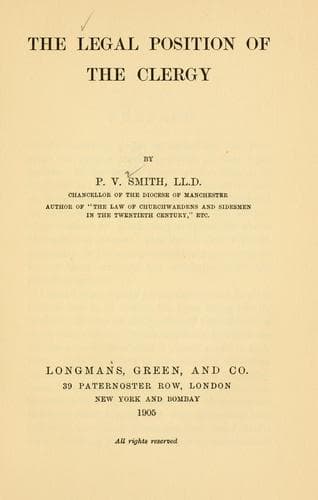
The Legal Position of the ClergySmith, Philip Vernon
Religion
The Legal Position of the Clergy
Smith, Philip Vernon
Canon law; Clergy -- Legal status, laws, etc. -- Great Britain; Ecclesiastical law -- Great Britain
published, and the description of the woman as a widow, when she was, in
fact, a spinster, is not an undue publication.[245] The banns must be
published from a book and not from loose papers, and after publication
must be signed by the officiating minister or some person under his
direction.[246] If, in the case of a minor, a parent or guardian openly
forbids the banns at the time of their publication by declaring or
causing to be declared his or her dissent to the marriage, the
publication will be void, and no marriage can be lawfully solemnised
upon it.[247] No other forbidding of the banns will render the
publication void. It can, at the utmost, only furnish a ground for
caution and inquiry as to further proceeding with the matter.
11. On the production and delivery of a certificate of the
superintendent registrar of births, deaths, and marriages of the
district in which a church or chapel is situate, that due notice of an
intended marriage in that church or chapel has been given, and also, if
one of the parties resides in another district, of a similar certificate
of the superintendent registrar of that district, the marriage may be
solemnised in such church or chapel, with the consent of the minister
thereof, but not otherwise, in like manner as after due publication of
banns. But a superintendent registrar cannot grant a licence for a
marriage in a church or chapel of the Church of England.[248]
12. A marriage may be solemnised, without banns or registrar's
certificate, under a licence of the bishop of the diocese or the
Archbishop of Canterbury for that purpose. A bishop's licence is granted
by the chancellor of the diocese, through the diocesan registry, for the
marriage of the parties in the church or chapelry of the parish in which
one of the parties has dwelt for fifteen days immediately preceding. The
licence, and also the form of affidavit leading to it, together with all
information on the subject, can be obtained either direct from the
diocesan registry or through a clergyman who is a chancellor's
surrogate. Before it is issued, an affidavit must be made before a
surrogate by one of the parties to the intended marriage that there is
no legal impediment to it, and that one of the parties has for fifteen
days immediately preceding the issue of the licence had his or her usual
place of abode in the parish or other district for banns and marriages,
in the church or chapel of which the marriage is to be solemnised.[249]
An ordinary or special licence can also be granted by the Archbishop of
Canterbury. His ordinary licence is issued under the same conditions and
has the same effect as a bishop's licence. But his special licence may
authorise the parties to be married in any church and at any time,
irrespectively of their places of residence and of the canonical hours.
On production of a licence for a marriage in a specified church, it is
the duty of the incumbent to perform the ceremony, unless he knows that
Public-domain text, read in full here on John Shaqi.
Reviews
Reviews
No reviews yet
Be the first to share your thoughts on this work.
Elsewhere in the archive
Join the Discussion
Join the discussion
Sign in to leave a comment or review.
Sign InorCreate an account