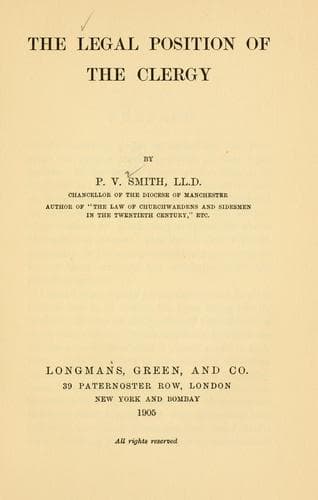
The Legal Position of the ClergySmith, Philip Vernon
Religion
The Legal Position of the Clergy
Smith, Philip Vernon
Canon law; Clergy -- Legal status, laws, etc. -- Great Britain; Ecclesiastical law -- Great Britain
14. On production of a certificate of marriage at a registry office, and
payment of the customary fees (if any), a clergyman may, if he sees fit,
read or celebrate the marriage service over the parties in his church;
but this is not to invalidate the previous marriage, nor is the reading
or celebration to be entered as a marriage in the parish register.[260]
There have, however, been cases of a subsequent marriage in church, not
only after a marriage before a registrar, but also after a marriage out
of England, the wife's maiden name being used on the occasion.[261]
15. The right to fees for publication of banns, giving a certificate of
banns where the marriage takes place in the other church in which they
were published, and the marriage itself, can only depend in ancient
parishes upon custom, presumed to date from time immemorial. A claim to
a marriage fee of 13s. (10s. for the rector and 3s. for the clerk) was
disallowed on the ground that the amount was unreasonably large and
could not have been paid in the time of Richard I.[262] In new
ecclesiastical parishes a claim for these fees can only be enforced if
they have been set out in a table of fees settled by the Church Building
Commissioners or their successors, the Ecclesiastical Commissioners,
under the Church Building Act, 1819, or by the chancellor of the diocese
under the new Parishes Acts, 1843 and 1856.[263]
16. Marriage register books in duplicate are furnished by the
Registrar-General to the incumbent of every church or chapel in which
marriages may be solemnised; and it is the duty of every clergyman who
solemnises a marriage to enter immediately afterwards in duplicate in
two of the books the prescribed particulars of the marriage; and the
entry is to be signed by him and by the parties married and by two
witnesses. An incumbent is to allow searches in all marriage register
books in his custody at a fee of 1s. for one year and 6d. for every
additional year to which the search extends, and 2s. 6d. for a
certificate (besides 1d. for the stamp). In every January and succeeding
third month he must send in to the superintendent registrar of births,
deaths, and marriages for the district, either directly or through a
subordinate registrar, a certified copy of all the entries made by him
since his last return, and will receive 6d. for every such entry. And
whenever a register book is filled, he is to send one copy to the same
registrar and keep the other copy with the registers of baptisms and
burials of his parish or chapelry.[264]
Public-domain text, read in full here on John Shaqi.
Reviews
Reviews
No reviews yet
Be the first to share your thoughts on this work.
Elsewhere in the archive
Join the Discussion
Join the discussion
Sign in to leave a comment or review.
Sign InorCreate an account