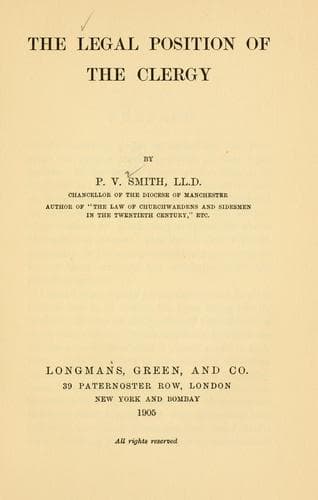
The Legal Position of the ClergySmith, Philip Vernon
Religion
The Legal Position of the Clergy
Smith, Philip Vernon
Canon law; Clergy -- Legal status, laws, etc. -- Great Britain; Ecclesiastical law -- Great Britain
17. If persons residing in the parish present themselves for Holy
Communion as married, a clergyman has no right, (_a_) in the absence of
any ground for suspicion to the contrary, to demand proof of their
marriage before admitting them, or (_b_) to refuse to admit them on a
mere suspicion that they are not married and therefore living in sin. If
he refuses them Communion, he must be prepared to show either (_a_) that
they actually are not married, or (_b_) that he had good grounds for
believing this to be the case. He is bound to recognise as man and wife
persons who have been duly married according to the law affecting them
at the time of the marriage, whether ecclesiastically or civilly, and
whether in this country or elsewhere; provided that the law was
Christian and monogamous; for a marriage according to a law, custom, or
rite which contemplates polygamous unions is void in our law.[265] If
there is any doubt as to the validity of their marriage, he will always
be on the safe side in adopting the affirmative view and acting upon the
assumption of their being validly married. In the absence of evidence to
the contrary, the law will presume a valid marriage from the fact of
long reputation and cohabitation as man and wife, without actual proof
of the ceremony having taken place.[266] A marriage is legally valid if
performed according to the mode and with the formalities required by the
law of the place where it is solemnised.[267] But the capacity of the
parties to contract marriage is governed by the law of their domicile;
and therefore persons domiciled in this country between whom a marriage
would be illegal here, cannot contract a lawful marriage by going for
the purpose into another country where such a marriage is legal, and
there going through the ceremony.[268] Under the English common law a
marriage between British subjects in a foreign country or on board ship,
where no statute law binding upon them imposes any further formalities,
is recognised as valid in this country if solemnised without banns or
licence in the presence of a clergyman of the Church of England, whether
priest or deacon (not being one of the parties to it).[269] A marriage
between British subjects may also be solemnised outside the United
Kingdom in accordance with the regulations of the Foreign Marriage Act,
1892 (55 & 56 Vict. c. 23), before a person authorised thereunder to act
as a marriage officer, as it might have been before that Act under the
Acts thereby repealed.
Footnotes
[213] Davis _v._ Black (1841) 1 Q. B. 900; Reg. _v._ James (1850) 3 C. &
K. 167.
[214] (1823) 4 Geo. 4, c. 76, ss. 21, 22.
[215] _Ib._ s. 2.
Public-domain text, read in full here on John Shaqi.
Reviews
Reviews
No reviews yet
Be the first to share your thoughts on this work.
Elsewhere in the archive
Join the Discussion
Join the discussion
Sign in to leave a comment or review.
Sign InorCreate an account