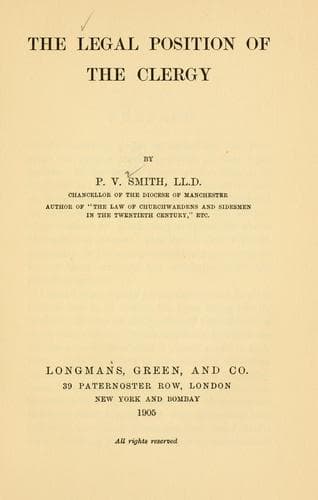
The Legal Position of the ClergySmith, Philip Vernon
Religion
The Legal Position of the Clergy
Smith, Philip Vernon
Canon law; Clergy -- Legal status, laws, etc. -- Great Britain; Ecclesiastical law -- Great Britain
whichever is the longer period, or if they were not paid to the
incumbent or to a person claiming through him, then during fifteen years
from that date; and the burial authority are to collect and pay them in
like manner as fees for services rendered; and (_b_) the Ecclesiastical
Commissioners may, at the request and with the approval of the incumbent
or other interested person, agree with a burial authority for a
periodical or other payment in commutation of the fees other than for
services rendered; and where the fees are paid to an incumbent or a
person claiming through him, the Ecclesiastical Commissioners are to
apply the commutation money in the first instance in compensating the
existing incumbent, and the residue in augmenting the benefice. (iii.)
No fee other than fees payable to a sexton for services rendered by him,
is to be paid to any clerk or other ecclesiastical officer in respect of
interments in the ground of a burial authority; except that a clerk or
other ecclesiastical officer who, on 10th July 1900, was entitled to
fees in respect of interments in any such ground, might apply to the
burial authority for compensation for their abolition, and they were to
pay him such equitable amount of compensation as might be agreed upon or
be directed by the Home Secretary in default of agreement. (iv.) The
foregoing provisions extend to cases where an annual sum had been
substituted for fees under 15 & 16 Vict. c. 85, s. 37.[310]
10. A body may be cremated instead of being buried;[311] and a faculty
has been granted for the interment of an urn containing the ashes of a
cremated body below the floor of a church, in spite of the church and
churchyard having been closed for burials under the Burial Acts.[312]
And there is no reason why, upon the committal of cremated ashes to
consecrated ground, the Burial Service should not be used as fully as
over an uncremated body. But the disinterment, for the sake of being
cremated, of a body which has been once buried is not permitted.[313]
11. A body which has been buried in consecrated ground cannot be
disinterred for reinterment elsewhere in consecrated ground, except
under the authority of a faculty, which will be granted in proper cases
upon the petition of the representatives of the deceased, with the
consent of the incumbent and churchwardens and a certificate of the
local medical officer of health that the proceeding will not be
dangerous from a sanitary point of view.[314] And except in the case of
removal from one consecrated spot for reinterment in another, a body, or
the remains of a body, which has been interred in any place of burial
may not be removed without the licence of the Home Secretary and with
such precautions as he may prescribe.[315]
Footnotes
[270] Com. Dig. tit. Cemetery (B); Gilbert _v._ Buzzard (1821) 2 Hag.
Cons. 333; R. _v._ Coleridge (1819) 2 B. & Ald. 806; R. _v._ Stewart
(1840) 12 A. & E. 773, 777.
[271] Cripps, 759.
Public-domain text, read in full here on John Shaqi.
Reviews
Reviews
No reviews yet
Be the first to share your thoughts on this work.
Elsewhere in the archive
Join the Discussion
Join the discussion
Sign in to leave a comment or review.
Sign InorCreate an account