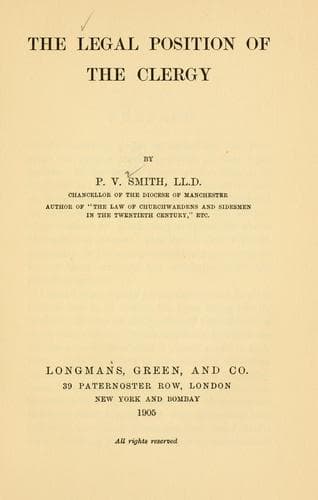
The Legal Position of the ClergySmith, Philip Vernon
Religion
The Legal Position of the Clergy
Smith, Philip Vernon
Canon law; Clergy -- Legal status, laws, etc. -- Great Britain; Ecclesiastical law -- Great Britain
not consecrated or set apart for a particular denomination, a chapel for
the joint common use of all denominations. They may also, at the request
and cost of residents within the burial district of a particular
denomination, erect and maintain a chapel for the funeral services of
that denomination on ground appropriated for their use. If a burial
authority fail to do this within a reasonable time after the request has
been made and the cost has been tendered or adequately secured, the Home
Secretary may, if he thinks fit, order and compel the burial authority
to erect and maintain the chapel or give facilities for its being
done.[306] Where a burial ground has been provided by a local authority
under the Burial Acts, the incumbents, clerks and sextons, of the
ecclesiastical parishes for which the ground has been provided, had, in
respect of the burial of inhabitants of those parishes in the
consecrated part of the ground, the same right to fees as they had in
the churchyard for which the ground is substituted, or would have had in
that churchyard if it had been the parochial burying place for their
respective parishes.[307] And the burial authority were empowered to
sell rights of burial in vaults and permit the erection of monuments,
with a reservation of such fees to the incumbent of each parish as he
would have been entitled to in the old churchyard, or as might be fixed
by the vestry of the parish with the approval of the bishop.[308] But
the law as to fees in these burial grounds was considerably modified by
the Burial Act, 1900. Under this Act (i.) burial authorities are to
submit to the Home Secretary for his approval, either with or without
modification, a table of fees to be received by them (of the same amount
in the consecrated and unconsecrated parts of their burial ground) in
respect of services rendered by any minister of religion or sexton; and
if an authority fails to submit a table, the Home Secretary may himself
make one. The fees are to be collected by and payable to the burial
authority with their other fees, and are to be paid over to the minister
or sexton in such manner as may be agreed upon, or as may be directed by
the Home Secretary in default of agreement. (ii.) In the ground of a
burial authority no fee in respect of any right of exclusive burial or
the erection of a monument or any matter other than services rendered by
the incumbent[309] is to be payable either to the incumbent or to the
churchwardens, or any trustees or other persons to which fees were
previously payable by law or custom for any parochial purpose or the
discharge of any debt or liability, with the following exceptions,
namely: (_a_) where on 10th July 1900 fees other than for services
rendered were paid in a burial ground attached to or used for the
purposes of a parish, the like fees are to continue payable during the
incumbency of the then incumbent or during fifteen years from that date,
Public-domain text, read in full here on John Shaqi.
Reviews
Reviews
No reviews yet
Be the first to share your thoughts on this work.
Elsewhere in the archive
Join the Discussion
Join the discussion
Sign in to leave a comment or review.
Sign InorCreate an account