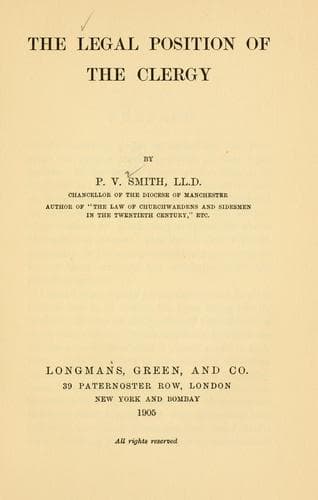
The Legal Position of the ClergySmith, Philip Vernon
Religion
The Legal Position of the Clergy
Smith, Philip Vernon
Canon law; Clergy -- Legal status, laws, etc. -- Great Britain; Ecclesiastical law -- Great Britain
[307] (1852) 15 & 16 Vict. c. 85, s. 32; (1857) 20 & 21 Vict. c. 81, s.
5; St. Margaret's Rochester Burial Board _v._ Thompson (1871) L. R. 6 C.
P. 445; Gell _v._ Mayor of Birmingham (1864) 10 L. T. N. S. 497; Day
_v._ Barnsley Burial Board (1865) 6 N. R. 156; Cronshaw _v._ Wigan
Burial Board (1873) L. R. 8 Q. B. 217; 42 L. J. Q. B. 137; Ormerod _v._
Blackburn Burial Board (1873) 21 W. R. 539; White _v._ Norwood Burial
Board (1885) 16 Q. B. D. 58; Stewart _v._ West Derby Burial Board (1886)
34 Ch. D. 314; Wood _v._ Headingley-cum-Burley Burial Board (1892) 1 Q.
B. 713.
[308] (1852) 15 & 16 Vict. c. 87, s. 33.
[309] This will include services rendered by a clergyman acting for the
incumbent, as well as by the incumbent himself. See 15 & 16 Vict. c. 85,
s. 32.
[310] 63 & 64 Vict. c. 15, s. 3.
[311] Reg. _v._ Price (1884) 12 Q. B. D. 247.
[312] _Re_ Kerr (1894) P. 284.
[313] _Re_ Dixon (1892) P. 386.
[314] Gibs. Cod. 454; Reg. _v._ Sharpe (1857) 26 L. J. M. C. 47.
[315] (1857) 20 & 21 Vict. c. 81 (Burial), s. 25.
CHAPTER VIII
PRIVATE MINISTRATIONS
1. The only private ministration for which detailed directions are
provided in the Prayer Book (other than Private Baptism, which has been
already noticed in Ch. V. § 6) is the Visitation of the Sick with the
Communion of the Sick in appropriate cases. With reference to this the
67th Canon directs that when any person is dangerously sick in the
parish, the minister or curate having knowledge thereof shall resort to
the sick person (if the disease is not known or reasonably suspected to
be infectious) to administer instruction and comfort according to the
order of the Communion Book if he be no preacher; or if he be a
preacher, then as he shall think most needful and convenient. And when
any one is passing out of this life a bell is to be tolled, and the
minister shall not then be slack to do his duty. The Order for the
Visitation contains several alternative forms to suit different
circumstances. Among these is the provision for confession and
absolution. The minister is in all cases to examine the sick person
whether he repent him truly of his sins and be in charity with all the
world, and is to exhort him to forgive from the bottom of his heart all
who have offended him. This direction does not contemplate any
confession either particular or general, except so far as profession of
repentance involves admission of sins to be repented of. But the
minister is further to move the sick person to make a special confession
of his sins if he feel his conscience troubled with any weighty matter;
and after this confession, if he humbly and heartily desires it, the
priest is to pronounce a prescribed form of absolution. It appears,
therefore, that confession is only contemplated if the sick person's
conscience is troubled with some weighty matter, and absolution is only
to be pronounced if (_a_) there has been confession, and (_b_) the sick
Public-domain text, read in full here on John Shaqi.
Reviews
Reviews
No reviews yet
Be the first to share your thoughts on this work.
Elsewhere in the archive
Join the Discussion
Join the discussion
Sign in to leave a comment or review.
Sign InorCreate an account