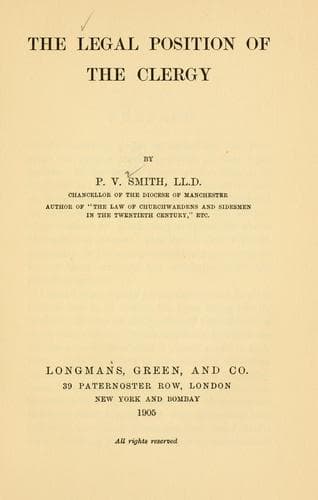
The Legal Position of the ClergySmith, Philip Vernon
Religion
The Legal Position of the Clergy
Smith, Philip Vernon
Canon law; Clergy -- Legal status, laws, etc. -- Great Britain; Ecclesiastical law -- Great Britain
person desires it. Communion of the sick may take place either along
with or apart from the visitation. In either case there must be three,
or at least two, in addition to the minister, to communicate with him,
except in time of plague or similar contagious illness, when the
minister may communicate with the sick person alone. In every case he
must receive the Communion himself first, and then administer to the
sick person's friends, and to the sick person last. After a special
Collect, Epistle, and Gospel, the Order of Holy Communion is to be
followed from the words "Ye that do truly and earnestly repent you of
your sins" onwards. The Church of England at present permits no
administration of any reserved Sacrament to the sick nor any further
abbreviation of the service.[316] If the sick person is too ill to
receive the Communion in the prescribed way, or is otherwise impeded, he
is to be instructed that, without doing so with his mouth, he eats and
drinks the Body and Blood of Christ to his soul's health if he truly
repents of his sins, and steadfastly and thankfully believes in the
redemption wrought by Christ's death on the Cross for him.
2. The Prayer Book requires the incumbent of every parish to bring or
certify in writing to the bishop all persons within the parish whom he
thinks fit to be presented to the bishop for confirmation. No special
mode of preparation for that rite is prescribed beyond public
instruction in the Catechism (see above, Ch. V. § 9). But this _minimum_
is rightly in the present day not considered sufficient. Special
confirmation classes and private interviews with intending confirmees
are now almost universal, and form one of the most responsible and
important parts of the pastoral duties of the clergy.
3. Besides the ordinary occasions of Confirmation and Sickness, the
minister may be called upon to give spiritual advice or comfort to
persons whom he knows to be living evil lives or to be at enmity with
their neighbours, or who are troubled in conscience about coming to Holy
Communion, or generally about their spiritual state. In the first Prayer
Book of Edward VI. the Exhortation to be said in giving previous notice
of Holy Communion where the people were negligent in coming to it,
contained injunctions to reconciliation and charity among neighbours and
restitution of wrongs, without which "neither the absolution of the
priest can anything avail them nor the receiving of this holy sacrament
doth anything but increase their damnation." And it then referred to
confession and absolution in these terms:--
Public-domain text, read in full here on John Shaqi.
Reviews
Reviews
No reviews yet
Be the first to share your thoughts on this work.
Elsewhere in the archive
Join the Discussion
Join the discussion
Sign in to leave a comment or review.
Sign InorCreate an account