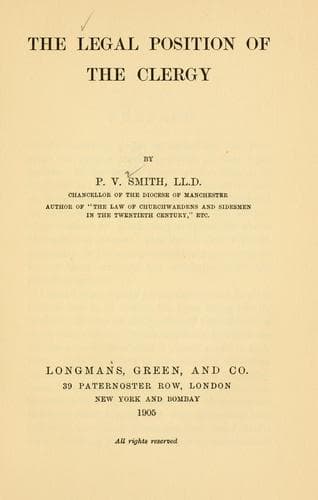
The Legal Position of the ClergySmith, Philip Vernon
Religion
The Legal Position of the Clergy
Smith, Philip Vernon
Canon law; Clergy -- Legal status, laws, etc. -- Great Britain; Ecclesiastical law -- Great Britain
3. The rights of an incumbent in the church and churchyard differ
according as the benefice is an ancient or a new parish, and in the
former case according as it is a rectory or a vicarage. The freehold of
the whole church in an ancient parish (except where a chapel or aisle or
a pew belongs to a private individual), and of the churchyard, belongs
to the rector, whether he be the incumbent or not;[319] and the chancel
is repairable by him, except where there is a custom for the
parishioners to keep it in repair. His duty in this respect can be
enforced by suit in the ecclesiastical court, and the churchwardens
cannot safely repair the chancel themselves and then sue him for the
cost.[320] But the incumbent and churchwardens (subject to the rights of
the bishop) have the possession and custody of the whole church,
including the chancel, and a lay rector cannot interfere with their
proper use of it; nor can any person claim to enter it, when not open
for Divine service, without their permission.[321] And the incumbent has
the paramount right to keep the keys of the church and to control the
use of the organ and the ringing of the bells.[322] But ringers are not
liable to criminal proceedings in the ecclesiastical court for ringing
the church bells without his consent, unless it was done against his
express desire.[323] Moreover, Canon 88 contemplates that the
churchwardens and sidesmen should have some control over the
bellringing; for it enjoins upon them not to allow the bells to be rung
superstitiously upon holy-days or eves abrogated by the Prayer Book, nor
at any other times without good cause to be allowed by the incumbent and
by themselves. And as regards the churchyard, unless there is a special
provision to the contrary in connection with his endowment, a vicar, as
against the rector impropriate, is only entitled to the possession of
the churchyard for spiritual purposes. The rector has a right to the
profits of the soil, and he or his tenants can depasture it with
sheep.[324] But a rector is only at liberty to fell the trees in the
churchyard when they are required for the repair of the chancel, or when
the body of the church requires repair and he voluntarily allows the
parishioners to use them for the purpose.[325] In new parishes the
freehold of the church and churchyard and of the vaults belonging
thereto is vested in the incumbent, except where it has been vested in
the vestry under a local Act and they have not consented to part with
it.[326] Neither incumbents nor rectors impropriate are liable in
respect of the church and churchyard to rates, nor to contributions
towards the expense of making and paving new streets.[327] So, too, an
incumbent was held not liable as owner for expenses incurred by a local
authority under a statute in removing a part of the church which had
become a dangerous structure.[328]
Public-domain text, read in full here on John Shaqi.
Reviews
Reviews
No reviews yet
Be the first to share your thoughts on this work.
Elsewhere in the archive
Join the Discussion
Join the discussion
Sign in to leave a comment or review.
Sign InorCreate an account