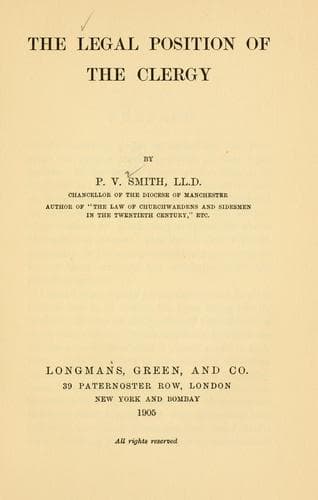
The Legal Position of the ClergySmith, Philip Vernon
Religion
The Legal Position of the Clergy
Smith, Philip Vernon
Canon law; Clergy -- Legal status, laws, etc. -- Great Britain; Ecclesiastical law -- Great Britain
[316] Archbishops' Hearing at Lambeth (1900) _Times_, May 2. The Prayer
Book of 1549 directed that if on the same day there was a celebration in
church, the priest should reserve (at the open Communion) so much of the
Sacrament of the body and blood as should serve the sick person and so
many, if any, as should communicate with him, and so soon as convenient
after the open Communion should go and minister the same first to any
appointed to communicate with the sick person, and last of all to the
sick person himself, after having previously made the general confession
and added the absolution and the comfortable words of Scripture as in
the Communion Office; and after the administration he was to say the
Collect "Almighty and everliving God, we most heartily thank," &c. But
if the day were not appointed for the open Communion, then the curate
should come and visit the sick person afore noon and celebrate the Holy
Communion according to the Order for the Communion of the Sick. But
these directions were omitted in 1552, and have not since been restored.
CHAPTER IX
TEMPORALITIES
1. The legal possessions and revenues of the benefice of an ancient
parish consist of (i.) the church and churchyard (subject to the use of
both for the benefit of the people), (ii.) the parsonage house and glebe
lands and buildings, (iii.) the tithe, (iv.) any modern endowments,
including perpetual annuities granted by the Ecclesiastical
Commissioners, (v.) ordinary dues and offerings, (vi.) mortuaries, and
(vii.) fees; and some of these possessions and revenues are also
attached to the benefice of a new ecclesiastical parish, which has,
moreover, in certain cases a further source of revenue in (viii.)
pew-rents.
2. The incumbent for the time being, whether of an ancient or new
parish, has a freehold interest for his life, if he so long remains
incumbent, in the possessions of the benefice, and for the purpose of
holding them is a corporation sole, with a continuous succession in
himself and all future incumbents. As such, he is subject to the general
laws respecting corporations, and also to those which regulate the
acquisition and holding of landed property for charitable purposes,
except so far as the law has made special exemptions in his favour.
Accordingly, except to the extent expressly permitted by statute, he
cannot in his corporate capacity, with perpetual devolution to his
successors in office, (_a_) acquire or hold additional landed property
without a licence in mortmain or in a manner inconsistent with the
provisions of the Mortmain and Charitable Uses Acts, 1888 and 1891,[317]
or (_b_) hold landed property upon any trust or for any purpose other
than as part of the possessions of the benefice.[318]
Public-domain text, read in full here on John Shaqi.
Reviews
Reviews
No reviews yet
Be the first to share your thoughts on this work.
Elsewhere in the archive
Join the Discussion
Join the discussion
Sign in to leave a comment or review.
Sign InorCreate an account