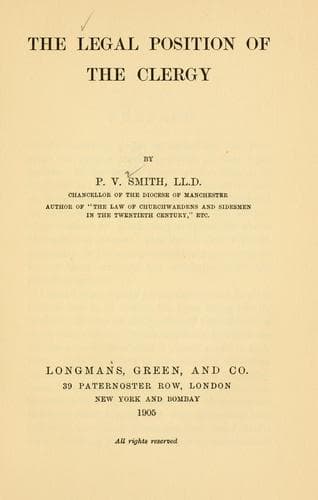
The Legal Position of the ClergySmith, Philip Vernon
Religion
The Legal Position of the Clergy
Smith, Philip Vernon
Canon law; Clergy -- Legal status, laws, etc. -- Great Britain; Ecclesiastical law -- Great Britain
6. In modern times the provision of parsonage houses and of other
necessary buildings on glebe lands, and the repairs of chancels liable
to be repaired by rectors, have been facilitated by special legislation.
In 1777 and 1781 the Gilbert Acts were passed,[346] which, as amended by
Acts of 1826 and 1838,[347] enabled an incumbent, with the consent of
the bishop and patron, or, during a vacancy in the living, the bishop,
to borrow money for the purpose of providing a parsonage house, or
rebuilding it in case of its having become ruinous, upon the security of
a mortgage of the income of the benefice for thirty-five years. The loan
was not to exceed the amount of the gross net income of the benefice,
and was to be repayable with interest by thirty yearly instalments. The
Governors of Queen Anne's Bounty were empowered to lend money for the
purposes of the Acts; and, in practice, the loans are generally
obtained from them. A later statute[348] extended these provisions to
the purchase of land convenient to be used with the parsonage house or
existing glebe land, and to the repair of the chancel in cases where it
is repairable by the incumbent, and to the building or improving of farm
houses or buildings or labourers' dwelling-houses on the glebe land; and
subsequent Acts have extended the time for repayment of the loans.[349]
Another series of enactments has specially sanctioned gifts and bequests
for providing parsonage houses and glebe;[350] and under a third series
incumbents are empowered to sell the parsonage houses and glebe lands of
benefices, or exchange them for others of greater value or more
conveniently situated, and to acquire new parsonage houses and
additional glebe lands.[351]
7. When an incumbent has a licence from the bishop to reside elsewhere
than in the parsonage house, he may let the house, subject to an
obligation on the part of the tenant to give up possession on the bishop
ordering the incumbent to resume residence therein.[352]
8. An incumbent may either himself farm his glebe (see Ch. 1. § 16
above) or let it to tenants. The tenants, however, will have no rights
against his successors unless the leases to them are made in accordance
with the statutory provisions for the purpose. These provisions enable
an incumbent, subject to certain restrictions and with the consent of
the bishop and patron, to let the glebe on farming leases for fourteen
years or, in some cases, for twenty years,[353] and under special
conditions to grant leases of it for longer periods for building and
mining purposes.[354]
9. An incumbent, as having an interest in the parsonage house and other
buildings of the benefice only during his incumbency, was always bound
to keep them in repair for the benefit of his successors.[355] His exact
liability in this respect and also in respect of insuring against fire
is now regulated by the Ecclesiastical Dilapidations Act, 1871.[356]
Public-domain text, read in full here on John Shaqi.
Reviews
Reviews
No reviews yet
Be the first to share your thoughts on this work.
Elsewhere in the archive
Join the Discussion
Join the discussion
Sign in to leave a comment or review.
Sign InorCreate an account