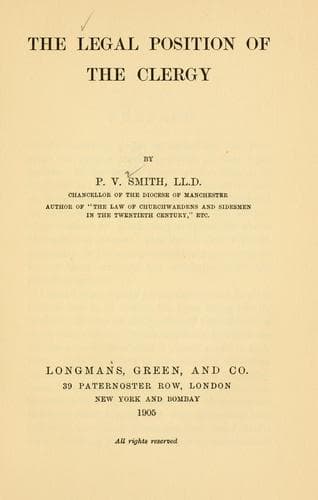
The Legal Position of the ClergySmith, Philip Vernon
Religion
The Legal Position of the Clergy
Smith, Philip Vernon
Canon law; Clergy -- Legal status, laws, etc. -- Great Britain; Ecclesiastical law -- Great Britain
10. Under this Act diocesan surveyors are appointed in every diocese to
inspect and report as to requisite repairs and to certify as to their
due execution. The proceedings vary according as they take place (_a_)
upon a vacancy in the benefice, or (_b_) at other times. But in either
case, after they have taken place, a certificate of the diocesan
surveyor that the requisite works have been completed in the parsonage
house and other buildings (including walls and fences, and, in the case
of a rector liable for its repair, the chancel of the church) will (in
the absence of wilful waste or of loss or damage by fire where the
incumbent has not kept up a sufficient fire insurance) confer exemption
from liability for dilapidations, in respect of those buildings, for the
next five years.
11. (_a_) Within three months after a benefice has become vacant,[357]
unless the late incumbent was for the time being free, in respect of all
the buildings of the benefice, from liability to dilapidations, the
diocesan surveyor will inspect the buildings or such of them as have not
been included in the exempting certificate, and will report to the
bishop what works and what sum, if any, are required for making good the
dilapidations. Either the new incumbent, or the late incumbent or his
executors or administrators, may send to the bishop objections to the
report, and the bishop will make an order specifying the repairs to
which the late incumbent or his estate is liable and the cost of them.
The amount of the cost thereupon becomes a debt from the late incumbent
or his estate to the new incumbent and may be recovered as such.[358]
Any money received in respect of it is to be paid to the Governors of
Queen Anne's Bounty, and they, with the consent of the bishop and
patron, may lend on the security of the possessions of the benefice, any
part of the cost which they have not received from the new incumbent.
Any additional balance required to make up the total amount of the cost
of the repairs must be paid to them by the new incumbent, and in case of
non-payment may be raised by sequestration of the profits of the
benefice. All the sums received or lent by them are to be placed in the
first instance to a dilapidation account. If a vacancy occurs in a
benefice between the time of an inspection of the buildings and the
certifying of the completion of the works, the former incumbent or his
estate will be liable for any portion of the cost of the required
repairs remaining unpaid by him, as a debt due to the new incumbent. But
the new incumbent, whether he recovers that portion or not, will be
under the same liability to pay for the outstanding cost of the repairs
as the former incumbent would have been had he continued to hold the
benefice; and any amount which he fails to recover from the former
incumbent or his estate may with the consent of the bishop and patron be
lent to him by the Governors of Queen Anne's Bounty on the security of
the profits of the benefice.
Public-domain text, read in full here on John Shaqi.
Reviews
Reviews
No reviews yet
Be the first to share your thoughts on this work.
Elsewhere in the archive
Join the Discussion
Join the discussion
Sign in to leave a comment or review.
Sign InorCreate an account