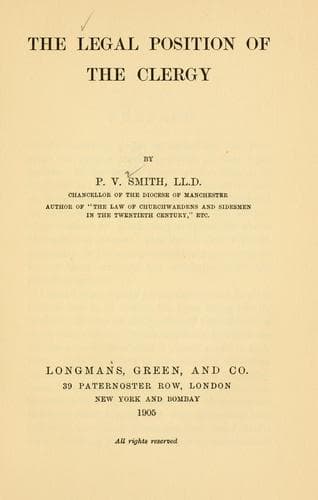
The Legal Position of the ClergySmith, Philip Vernon
Religion
The Legal Position of the Clergy
Smith, Philip Vernon
Canon law; Clergy -- Legal status, laws, etc. -- Great Britain; Ecclesiastical law -- Great Britain
12. (_b_) On a written complaint of the archdeacon, the rural dean, or
the patron, that the buildings of a benefice are dilapidated, or at the
request of the incumbent himself, the bishop, although no vacancy has
occurred, may direct the diocesan surveyor to inspect the buildings,
unless, in the case of a complaint on the subject, the incumbent is
himself ready to put the buildings in proper repair, and the bishop is
satisfied that this is actually done. Such inspection may also be
directed within six months after the sequestration of a benefice, and is
to be renewed in every fifth year while the sequestration continues. The
surveyor, in like manner as in the case of a vacancy, will report to the
bishop the works needed and their probable cost. The incumbent or the
sequestrator may state objections to the report, and the bishop will
give his decision in writing. If the benefice is not under
sequestration, the Governors of Queen Anne's Bounty may, with the
consent of the bishop and patron, lend on the security of the
possessions of the benefice the whole or any part of the cost of the
required works. The amount of the loan will be placed to a Dilapidation
Account, and it will be the duty of the incumbent to execute the
required works in the prescribed manner. If he fails to do so, the cost
may be raised by sequestration of the benefice, and the same course will
be taken as if that had occurred before the dilapidation proceedings had
commenced. In the case of a benefice under sequestration, the cost of
the required works is to be a charge on the income of the benefice which
comes into the hands of the sequestrator, and out of that income, after
providing for the performance of the duties of the benefice, he is to
pay the amount of the cost to the Governors of Queen Anne's Bounty, to
be placed by them to a dilapidation account. The proceedings are not to
be affected by any vacancy occurring in the benefice before the works
are executed, except so far as modification may be made in them as the
result of the report of the surveyor after his inspection consequent on
the vacancy, and except that if the benefice was under sequestration,
any unexpended amount standing to the dilapidation account of the
sequestrator is to be carried to the dilapidation account of the new
incumbent in reduction of the amount payable by the former incumbent or
his estate. A sequestrator who spends more on the repairs than is
authorised by the surveyor's report is personally liable for the
excess.[359]
Public-domain text, read in full here on John Shaqi.
Reviews
Reviews
No reviews yet
Be the first to share your thoughts on this work.
Elsewhere in the archive
Join the Discussion
Join the discussion
Sign in to leave a comment or review.
Sign InorCreate an account